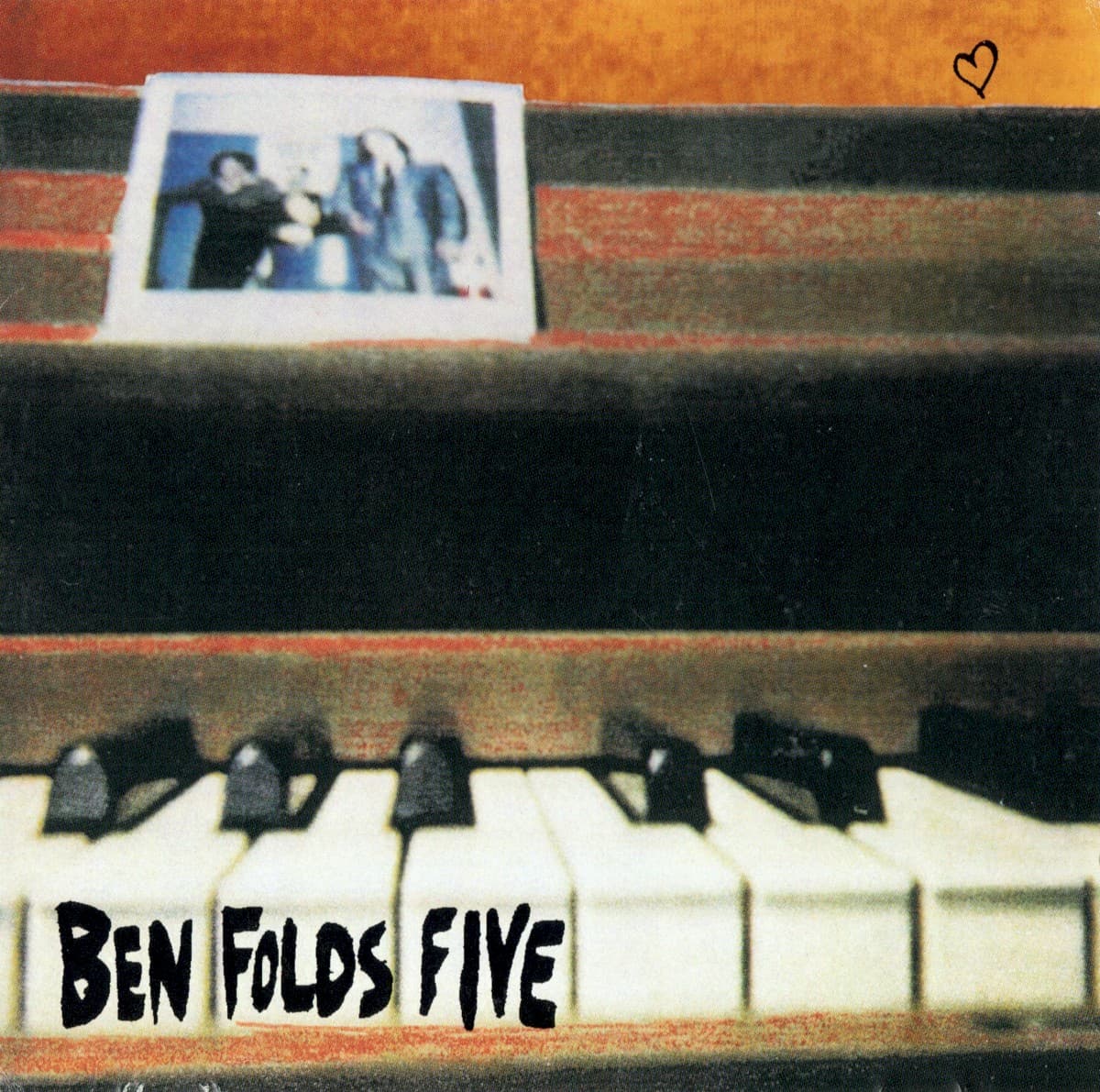
In 1995, alternative rock was full of distorted guitars. Ben Folds Five arrived with a piano. The trio's debut cover does not try to disguise that difference. The instrument sits at the center of the album's visual identity, surrounded by photographs, handwritten marks and an intentionally loose arrangement that feels closer to a rehearsal-room scrapbook than a glossy rock-star portrait.
That informality suits a band whose basic setup already sounded like a provocation: Ben Folds on piano, Robert Sledge on bass and Darren Jessee on drums. There were only three of them despite the name, and no guitarist. The debut was recorded in February 1995 at Wave Castle in Hillsborough, North Carolina, with Caleb Southern producing.
Alexandria Searls is credited for photography on the original album. Rather than turn those photographs into a conventional group portrait, the sleeve folds them into a larger collage language. Piano keys, small images and rough graphic gestures compete for attention. The result has the handmade energy of a band still close to the clubs and rooms where its identity formed.
That matters because Ben Folds Five did not enter the culture as an established act being carefully branded. Songs such as 'Underground' were already making fun of the codes of alternative credibility. The cover's looseness feels compatible with that stance: it uses the visual vocabulary of indie rock without pretending the trio fits neatly inside it.
The piano is the key. On many album covers, an instrument is merely a prop. Here it is practically a declaration of method. The keyboard immediately tells the viewer what makes this band structurally strange. Folds could attack the instrument rhythmically, Sledge's distorted bass could occupy space normally claimed by guitar, and Jessee could push the trio with the force of a rock band without changing the lineup.
Three decades later, that first album has returned to the foreground for an unusually concrete reason. In 2026, Folds announced an anniversary edition pairing the original record with a shelved first attempt, produced by Dave 'Stiff' Johnson and rediscovered on digital audio tape in Folds's archive. The abandoned version contains early takes, outtakes and material that later resurfaced elsewhere.
That rediscovery makes the debut cover feel newly appropriate. It has always looked like an artifact from a band in the act of figuring itself out. Now the anniversary edition literally places the finished record beside an earlier version of that process. What once looked merely casual has become a visual introduction to an album with two histories.