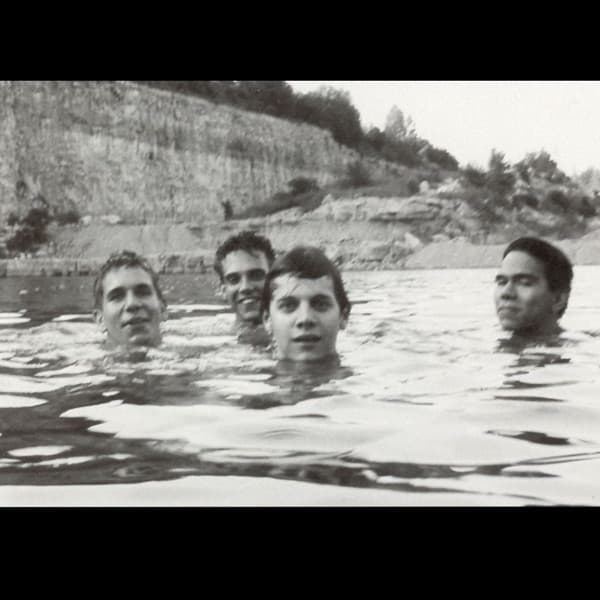

The cover of Spiderland emerged from a spur-of-the-moment decision at a limestone quarry in Louisville, Kentucky, creating one of the most haunting album covers in alternative rock history. Will Oldham, who would later gain fame as Bonnie "Prince" Billy, captured the band floating in the dark, murky water of McNeely Lake Quarry on a whim during the summer of 1990.
The concept wasn't planned at all — Oldham simply suggested they take some photos while hanging out at the popular local swimming spot. The quarry had been a refuge for Louisville's underground music scene, a place where bands would go to escape the heat and the pressures of their intense creative processes. Slint had just finished recording their groundbreaking album, and the water seemed like the perfect antidote to the claustrophobic studio sessions.
Oldham used a simple camera to capture the four band members — Brian McMahan, David Pajo, Britt Walford, and Todd Brashear — as they floated motionless in the quarry's dark water. The limestone walls rising around them created a natural amphitheater, while the water's opacity suggested depths both literal and metaphorical. The image captured something unsettling about the way the figures seemed suspended between life and death, consciousness and oblivion.
The execution was deliberately lo-fi and spontaneous. Oldham shot multiple frames as the band members experimented with different positions in the water, some floating on their backs, others partially submerged. The water's natural murkiness obscured their bodies below the surface, creating ghostly, fragmented figures. The limestone quarry walls provided a stark, almost industrial backdrop that complemented the album's spare, mathematical approach to rock music.
The photograph perfectly embodied the band's aesthetic philosophy — stark, unadorned, and deeply unsettling. Oldham and the band members shared a vision of art that rejected typical rock and roll imagery in favor of something more literary and existential. The image suggested drowning, rebirth, or perhaps just the peculiar weightlessness that comes with artistic breakthrough.
Will Oldham was already an established figure in Louisville's tight-knit indie scene, having appeared in several independent films and begun his own musical career. His eye for capturing the uncanny in everyday situations made him the perfect photographer for Slint's uncompromising vision. The band members trusted his instincts completely, allowing him to direct the shoot with minimal interference.
When Touch and Go Records received the photograph, label head Corey Rusk immediately recognized its power. The image required no additional design elements or typography treatments — it spoke entirely for itself. The stark simplicity aligned perfectly with Touch and Go's aesthetic of letting the music and imagery speak without commercial compromise. Steve Albini, who had produced the album, reportedly called it "perfect" in its directness.
Critics and fans were immediately struck by the cover's haunting quality, though many didn't initially know the backstory of its creation. The image became synonymous with the album's themes of isolation, mathematical precision, and emotional intensity. Music journalists frequently described the cover as capturing the sound of the album — dark, mysterious, and deeply affecting. The photograph helped establish Spiderland as a visual as well as sonic masterpiece.
The cover's influence on indie and post-rock album artwork cannot be overstated. Countless bands have attempted to recreate its combination of spontaneous photography and existential weight, though few have matched its effortless perfection. The image helped establish a template for alternative rock photography that prioritized authenticity over polish, mystery over explanation. It proved that the most powerful album covers often emerge from genuine moments rather than calculated marketing strategies.
The Spiderland cover became a touchstone for photographers working in music, inspiring a generation of artists to seek out liminal spaces and unexpected moments of beauty. Its influence can be seen in everything from Godspeed You! Black Emperor's apocalyptic imagery to the intimate photography of indie rock bands throughout the 1990s and 2000s. The photograph helped establish quarries, abandoned buildings, and other industrial spaces as legitimate subjects for album artwork.
Decades later, Will Oldham still receives inquiries about the shoot, though he's always maintained that its power came from its complete lack of pretension. The band members were simply cooling off in their favorite swimming spot, and he happened to have a camera. That combination of artistic instinct and perfect timing created an image that continues to resonate with new generations of listeners discovering Spiderland's revolutionary music.