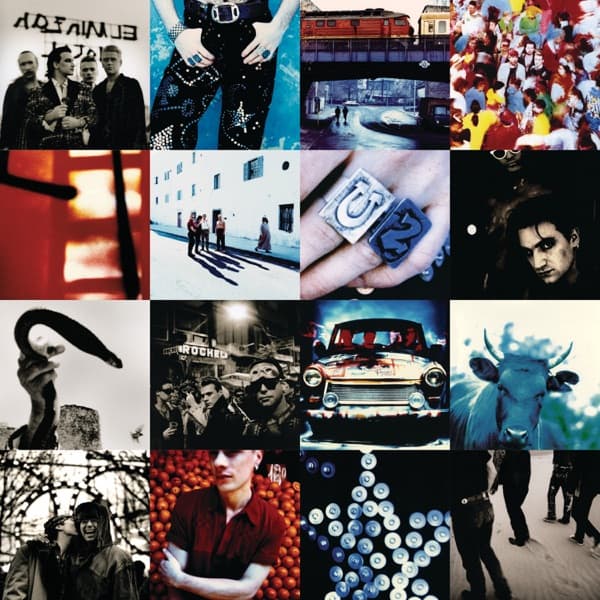
Look for the band and your eye refuses to settle. The cover of Achtung Baby is a 4×4 grid of sixteen separate photographs, and no single one of them wants to be the cover. Top left, four men in a smoky black-and-white frame stare out beneath reversed lettering, the most U2-looking image on the sheet, and the rest of the grid spends its energy contradicting it.
That contradiction was the entire point. Steve Averill art-directed and Shaughn McGrath designed the sleeve at Works Associates, both of them newly arrived at the firm, working from a huge body of photographs by Anton Corbijn. To mirror how the music was lunging toward alternative, industrial, and electronic dance, they refused the serious, mostly monochromatic look of earlier U2 covers. The band, Corbijn, Averill, and the producers all felt the sense of flux was best caught by having no single viewpoint at all. So sixteen viewpoints it became.
Corbijn shot the band across continents: Berlin in late 1990, Tenerife in February 1991, Morocco in July, and a Dublin studio. The earliest Berlin sessions were rejected by the band themselves, who feared another grim grey sleeve. The Tenerife carnival yielded what they wanted. You can read that shift across the grid: a red-soaked close-up of a man with painted eyes, figures in carnival masks crowding a neon street, a young man in a red shirt folded against a wall of oranges, all colour and play and confusion meant to confound anyone expecting earnest stadium rock.
Then there are the Trabants. Those boxy East German cars had become a symbol of Communism's collapse, and the band had developed a real affection for them. Berlin Wall artist Thierry Noir painted them in bright spatters, and one sits dead-centre-right in the grid, grille glowing, windscreen full of shadowed faces, the most joyful wreck imaginable. Decades later, for the album's 30th anniversary in 2021, U2 reunited with Noir on an installation at Hansa Studios pairing a freshly painted Trabant with a section of the Berlin Wall.
Scan the other tiles and the band keeps slipping into disguise. They were photographed in drag in Tenerife and Morocco, mingling with carnival crowds. A blue-tinted cow stares out from one square, horns and wet nose filling the frame, a leftover from one of the rejected single-cover ideas: that very cow, photographed on a farm in County Kildare. The band also weighed a shot of themselves driving a Trabant, and a nude photograph of bassist Adam Clayton.
The nude nearly retitled the whole thing. U2 considered calling the album Adam, pairing it with Clayton's full-frontal image. Instead the photo went on the back cover of the vinyl, and some territories balked at it, so McGrath painted a large 'X' over the offending area. It is the kind of detail that tells you how loose and improvised this reinvention still was.
The handmade quality runs deeper than that X. McGrath drew the album and song-title typography himself, brush and ink on paper, in the final days before computers arrived in the design studio. So the lettering that fronts U2's most electronic, machine-leaning record was made by hand, the analogue last gasp on the threshold of the digital one. Sixteen photographs, three countries, a painted car, a censored body, a blue cow, all stitched into a single restless square that Island Records sent into the world on 18 November 1991, daring you to find the band in the noise.