Behind the Covers
The Joshua Tree by U2 — album cover art

The Joshua Tree

U2 · 1987

3 min readPublished

Photographer
Anton Corbijn
Label
Island Records
Decade
1980s

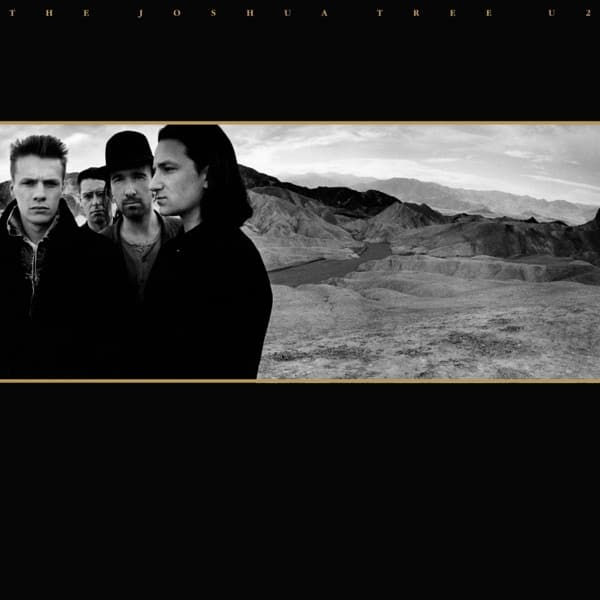
The four faces look cold, and they were. In December 1986 the men of U2 stood at Zabriskie Point in Death Valley, peeled off their coats so the picture would read as desert heat, and let the freezing air do the rest. Bono later admitted that grim, hollow-eyed seriousness on the cover came partly from the temperature. The body remembers what the eye cannot see.

Look at the photograph and you understand the trade they made. The band fills the left third of a horizontal panel, four men in black, tightly grouped, every gaze pulling in a different direction so the cluster feels watchful rather than posed. One wears a brimmed hat, another stares straight out at you, the rest drift toward the edges of the frame. Behind them the land opens into a vast, eroded basin of pale hills and a thin dark gully snaking toward distant mountains. The black-and-white image, all silver greys and deep shadow, sits framed in a thin gold line against a pure black field, like a window cut into the night.

This was Anton Corbijn's vision. The Dutch photographer travelled across the California desert with the band over several days, hunting the brief he had been handed: desert meeting civilization, resolution in the face of desolation. The working titles told the story before the songs did, The Two Americas and The Desert Songs, an attempt to hold the band's love-hate relationship with America inside a single frame of sand and ghost towns.

The album's name arrived on that journey almost by accident. On the evening after the first day's shoot, Corbijn told the band about Joshua trees, the strange spiked plants of the Mojave, and suggested they include one. The next day Bono declared it: the album would be The Joshua Tree. Its Biblical weight sealed the decision. On the second day Corbijn spotted a single tree standing alone off Route 190 near Darwin, a rarity since the trees usually grow in clusters, and the crew photographed it for roughly twenty minutes before moving on.

Steve Averill, the Dublin-born designer who has shaped every U2 cover from Boy to Songs of Innocence, art-directed and built the sleeve around that landscape. He described the whole theme as desert and ghost towns, places where nature and civilization collide, framed with a cinematic eye he traced to directors like John Ford and Sergio Leone. You can feel that widescreen ambition in the letterbox crop, the way the eye lands on the band and then is dragged out across the emptiness behind them.

Released on 9 March 1987 by Island Records, the album marked U2's turn toward American and Irish roots, blues, gospel, soul and folk, leaving behind the ambient post-punk of earlier years. The cover photographed at Zabriskie Point is not, as many assume, inside Joshua Tree National Park. The actual lone tree stood over two hundred miles away, in the desert west of Death Valley.

The afterlife of that image is its own strange chapter. The tree fell around the year 2000, yet fans still trek to the remote spot, where one of them planted a plaque reading 'Have you found what you're looking for?', a nod to the song 'I Still Haven't Found What I'm Looking For.' Even the parodists came calling: cartoonist Berkeley Breathed mocked the sleeve on the back of his book 'Billy and the Boingers Bootleg' that August. Forty years on, four cold men and one window of grey desert keep sending strangers into the sand to find something the photograph only promised.

Color palette

Dominant colors on this cover

#bd8341

#dcbe9c

#8c846c

#171008

#443c3c

This cover reads predominantly as black. Explore more covers with the same palette:

The web behind this cover

Click any node to open the full explorer

Loading the graph…

Explore the full Cover Connections graph →

Get a new cover story every week

One email, one iconic album cover — the designer, the story, and why it matters.

Get notified when we publish new cover stories. Download the Behind the Covers app and turn on notifications — a new album art deep dive, every day.

Loved the story behind The Joshua Tree? Hear the album or add it to your collection.

Keep exploring

Connections across Behind the Covers

Surfer Rosa by Pixies

Up next

Surfer Rosa

Pixies · 1988 · Vaughan Oliver

A topless flamenco dancer arches against a crumbling wall, a crucifix glinting beside her, a torn movie poster behind. Pixies' debut buries Catholic imagery, a broken guitar neck, and a strange tonal reversal into one sepia frame. The story of how it was built above a London pub in a single day is stranger than the photo.

Read this story →

Want to explore more?

Never miss a new cover story

Get the Behind the Covers app and turn on notifications — we publish new album art deep dives every day.