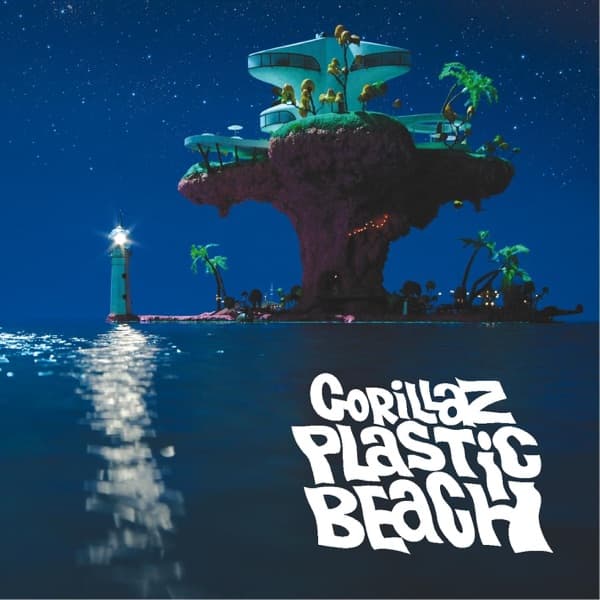
The eye lands first on the glowing structure at the summit, pale mint-green and lit from within, its rounded balconies stacked like the decks of a resort nobody remembers building. From there the gaze slides down the swollen trunk of the island to the waterline, where the ocean sits dark and glassy under a dome of stars. The composition is vertical and top-heavy: the island balloons outward as it rises, a mushroom of debris that seems to defy the thin rock supporting it.
Colour does much of the emotional work. The dominant register is deep blue-black, the night sky pricked with stars fading into the sea so that the horizon all but vanishes. Against that vast cool darkness, warm accents flicker: the mint interior glow of the summit structure, pinprick lights strung along the rock, the small burning eye of the lighthouse. The contrast reads as isolation, a tiny inhabited thing marooned in an endless, empty dark.
The lighthouse and its reflection form the picture's secondary focal path. Set apart on its own platform at the left, its beam lays a shimmering ladder of light across the black water straight toward the viewer, pulling you into the scene and reinforcing the sense of a lonely watch kept over nothing.
The image rewards a slow read. The tiny palm trees dotting the lower slopes, the lights along the base, and small craft scattered near the shoreline are easy to miss at a glance, so that a single look turns into an exploration. Nothing here reads as a quick digital composite; every element has the weight and specific lighting of a real object that was made and photographed, which is why the picture holds up to close inspection rather than dissolving.
Against all this photographic texture, the typography crashes in loud and hand-drawn. In the lower right corner, stacked in three chunky white lines, sit GORILLAZ / PLASTIC / BEACH, the letters wobbling and bulging as if brushed on fast and wet, corners rounded, edges uneven. It is cartoon lettering pasted over a photorealistic scene, and that clash is the joke and the identity of the whole project: the drawn band planted onto a real-world illusion, animation logic meeting a physical set.
The meaning gathers from the collision of these choices. The retro-futurist paradise is beautiful precisely because it is built from waste, a glowing utopia that is literally garbage piling up in the ocean. The stillness, the vanishing horizon, and the single sweeping beam of the lighthouse turn an environmental image into an emotional one: a fragile, artificial refuge glowing in the middle of a dark that has no edge.