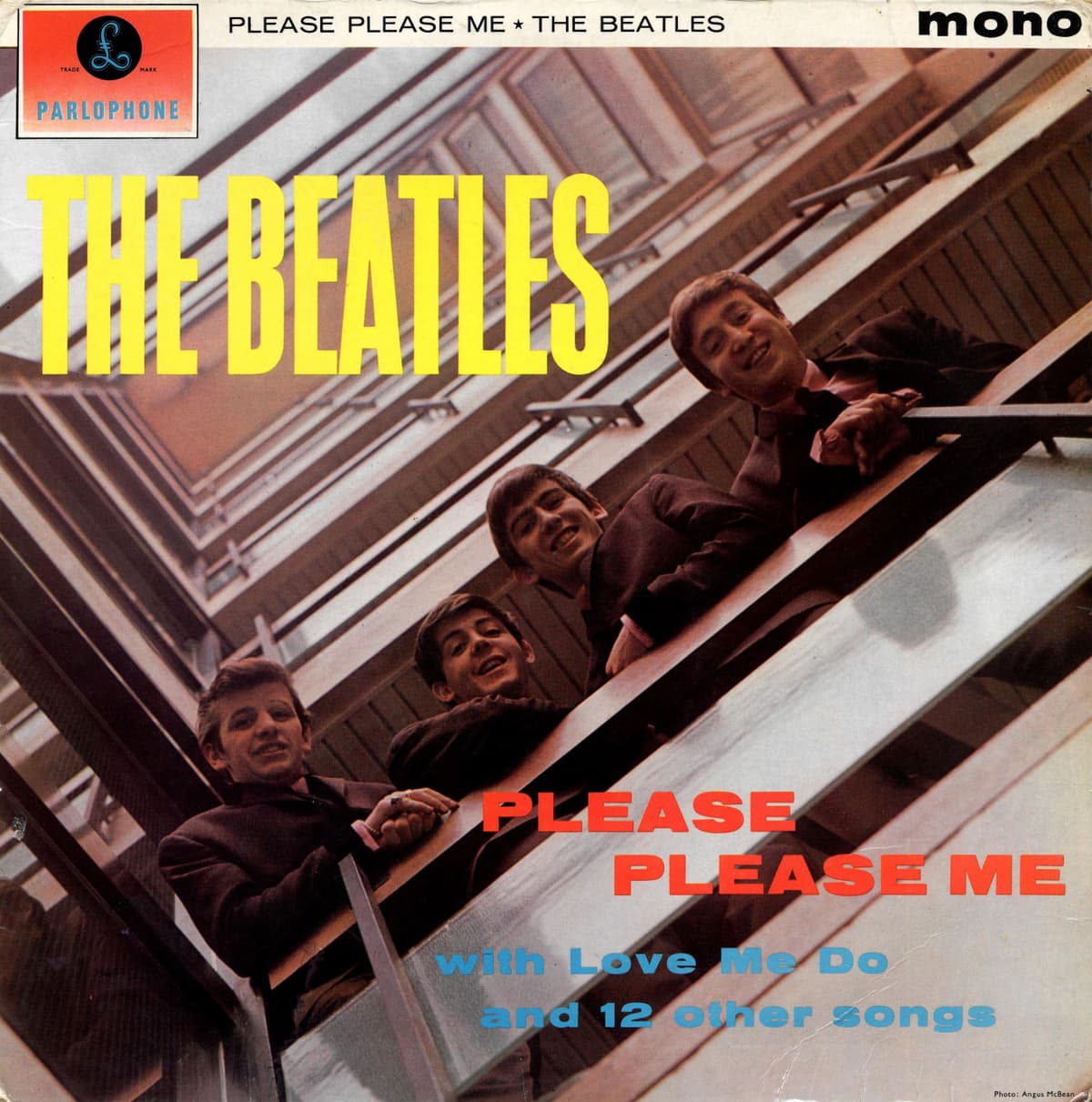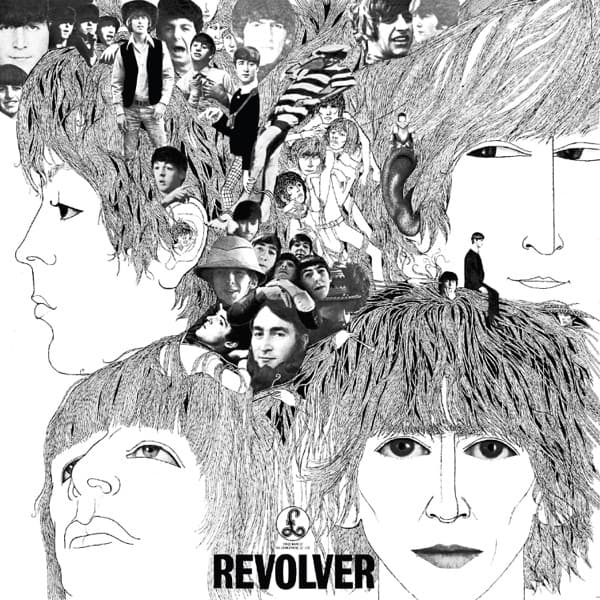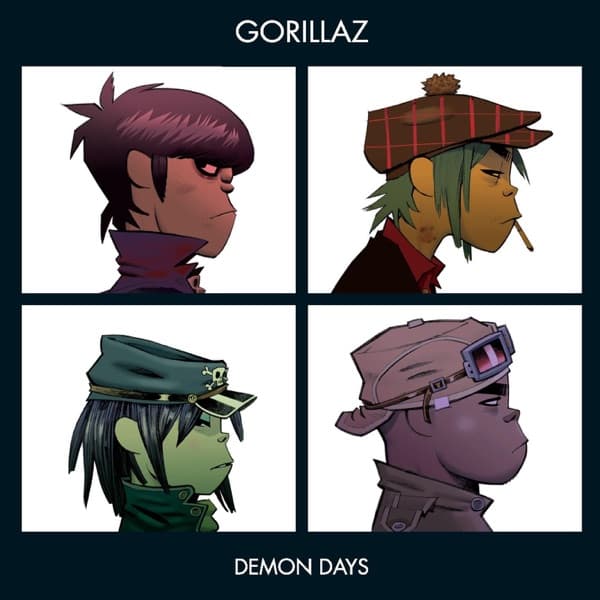


Look closer and the grid gives itself away. Four squares, four heads in strict side profile, each character sealed in its own panel against deep blue-black borders. It is the layout of the Beatles' final studio sleeve, and fans and critics caught the homage instantly: Gorillaz lining up their four fictional members the way four real men once stared out separately from a black square.
The faces are unmistakable to anyone who follows the band's invented mythology. Top left, Murdoc Niccals scowls under a sweep of dark maroon hair, his green skin shadowed, his expression sour. Top right, the green-haired 2D leans in a deerstalker-style cap with red plaid, a thin cigarette hanging from his lips, his eyes blacked out into hollow sockets. Bottom left, Noodle turns away in a military peaked cap stamped with a tiny skull and crossbones, her dark hair falling forward. Bottom right, the hulking Russel Hobbs faces the others in a worn cap, a small purple visor pushed up over his brow, his deep violet skin catching low light.
Everything here is illustration, and all of it came from one hand. Jamie Hewlett, the band's co-creator and credited as J.C. Hewlett, drew every line on paper first, scanning the work and coloring it digitally in Photoshop from his Shepherds Bush studio. The digital coloring was a technique he had only recently picked up, which makes the smooth gradients on these cheeks and the glow on Russel's visor feel like a craftsman testing a new tool in public. The artwork was produced under his own company, Zombie Flesh Eaters.
The palette tells you this is not the sunnier first chapter. Murals of muddy reds, sickly greens and bruised purples sit against that near-black surround, faces lit as if by a single dim bulb. Demon Days, released in 2005, was built as a loose concept album that Damon Albarn described as the world in a state of night, an idea he traced to a train journey through impoverished rural China. The cover carries that mood: closed-off profiles, downturned mouths, nobody quite meeting your eye.
The word GORILLAZ runs across the top in clean white sans-serif capitals, DEMON DAYS in the same font along the bottom. No clutter, no ornament. The typography stays out of the way so the four heads do all the talking, framed and squared like specimens or mug shots.
The album reached the world on 23 May 2005 through Parlophone, alongside Virgin Records. A limited edition pushed the four-panel concept further with a foldout X-shape, letting the owner choose which of the four characters they wanted facing out on the front. It turned the Beatles-style democracy of the grid into a small game of favorites.
The recognition followed fast. In January 2006 Hewlett's Gorillaz artwork was shortlisted for the Design Museum's Designer of the Year award, and that May he was named Designer of the Year 2006. It is a rare thing for a band's visual identity to win a design prize outright, but the proof is right here in a sleeve that hides hours of hand-drawing inside a layout so simple it reads in a single glance.
That is the quiet trick of this cover. It looks like four cartoon portraits in boxes. It is actually a reference, a mood piece and a prize-winning piece of drawing, all pretending to be nothing more than four faces looking away from each other in the dark.