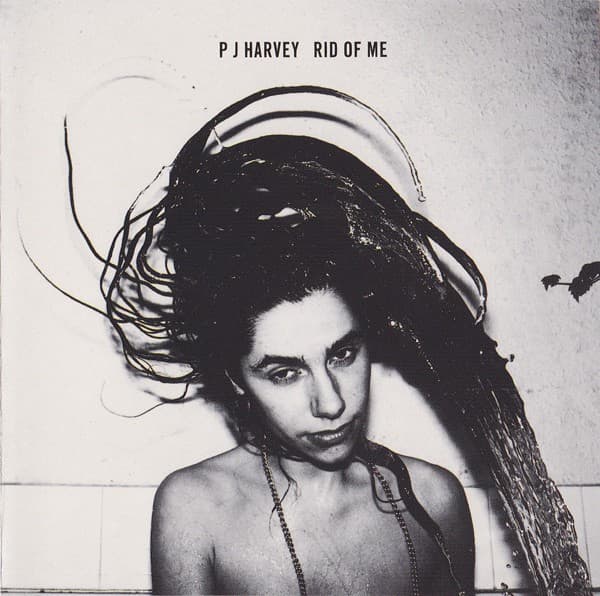


The cover of Rid of Me looks violent before you know anything about how it was made. PJ Harvey's face is still while her soaked hair lashes upward beside her like a solid black shape. There is no glamorous studio, no visible stage and almost no context. Just skin, wet hair, wall, tile and flash.
The photograph was made by Maria Mochnacz, Harvey's close friend and visual collaborator, in Mochnacz's bathroom in Bristol. The room was so small that Mochnacz had to push the camera against the opposite wall. She could not comfortably frame the image through the viewfinder, so Harvey had to work within rough directions while the photographer relied on timing and repetition.
Mochnacz knew what she wanted from the water. She later described trying to make Harvey's wet hair look almost sculptural, as though the motion had hardened for a split second. The room was kept in pitch black and the flash supplied the image's only burst of light. The result is why the hair feels less like hair than an object thrown through space.
The picture's rough surroundings were not an accident. When Mochnacz brought the photograph to the record company, she was told that the marks on the wall, the drips and the plant could be cleaned up. She refused. Those details belonged to the photograph. Their ordinariness keeps the image from becoming fashion photography; the picture feels immediate because the room still looks lived in.
That resistance matched the album around it. Rid of Me was PJ Harvey's first album for Island after the success of Dry, and the major-label move came with obvious pressure to become more legible and marketable. Harvey instead chose to record with Steve Albini, whose approach emphasized the physical force of the trio rather than smoothing it out. The cover behaves the same way. It takes a potentially glamorous portrait and leaves the abrasion intact.
The contrast is what makes the image endure. Harvey is exposed but not presented passively. Her expression is calm while the hair explodes around her. The photograph is intimate because it was made in a friend's bathroom, yet it feels confrontational enough to have caused its own reaction when the album appeared.
Mochnacz's work became central to the visual identity of this period. She also photographed the artwork for 4-Track Demos and directed videos including '50ft Queenie' and 'Man-Size.' Rid of Me therefore was not a one-off successful image; it helped establish a collaboration that made Harvey's early visual world as distinctive as the records themselves.