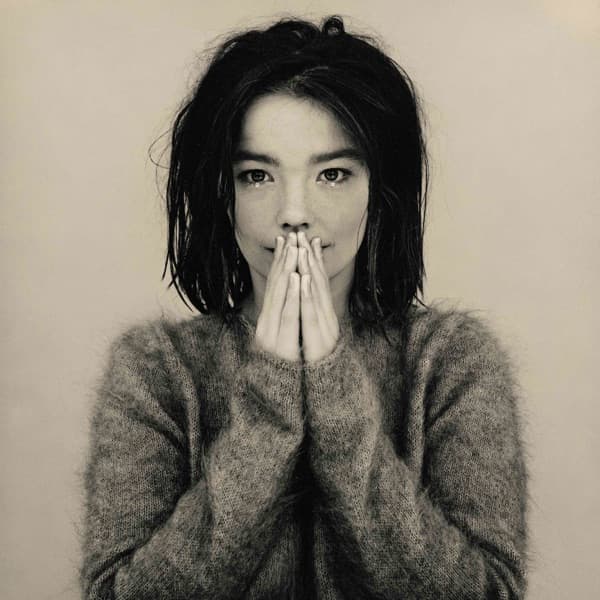
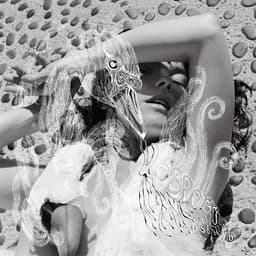


The first thing you meet is her eyes, wide and dark and looking straight back at you, and only after that do you notice she has hidden the rest of her face behind her own hands. Björk presses her palms together and lifts them to her mouth, fingertips reaching her nose, so that what should be a smile or a word is sealed away. It reads like a gesture caught between prayer and secret-keeping, the album called Debut choosing, of all things, to cover the very mouth that will sing it.
The photograph is by Jean-Baptiste Mondino, the French photographer who framed her against a plain, warm sepia backdrop with nothing to distract from the person. There is no set, no props, no colour to speak of beyond the soft brown wash across the whole square. Her dark hair is cut to a rough bob, damp-looking and slightly wild, a few strands falling loose across her forehead and cheek. She wears a fuzzy grey mohair sweater, its halo of fibres catching the light so that the wool seems to glow softly at the edges. The texture of that sweater against the smoothness of her skin is half the picture's tenderness.
The framing is tight and symmetrical, her shoulders squared to the camera, her joined hands forming a neat vertical column up the centre of the image. Your eye travels the natural path her body draws: up the soft grey chest, along the arms, to the steeple of fingers, and finally to those unblinking eyes. Because the mouth is gone, everything is thrown onto the gaze, and the effect is intimate to the point of confrontation. She is very close, and she is not smiling, and she does not look away.
The cover design is credited to Me Company, the London studio founded by Paul White that produced the vast majority of Björk's single and album artwork over the years. Here their hand is restrained, letting Mondino's portrait carry almost everything, the design working in the choices of tone and framing rather than in loud graphics. It is a quiet start to what would become one of the most visually adventurous partnerships in pop.
The title itself is loaded. Debut arrived on 5 July 1993, released by One Little Indian and Elektra Entertainment, and it was Björk's first record after the Sugarcubes, the band she had come from, had dissolved. So the covered mouth and the steady eyes take on the weight of a threshold. This was the moment she stepped out alone, and she named the record for exactly that: a beginning.
She would later make the framing explicit. Björk said she always knew there would be two albums, which is why she called them Debut and Post: before and after. That turns this portrait into the opening panel of a diptych, the face on the near side of a line she was about to cross. Holding her hands to her mouth becomes the pause before the leap, breath held, words not yet spoken.
What she was about to release was a sharp turn away from the rock of her past. Debut drew from an eclectic spread of styles, electronic pop, house music, jazz and trip hop, a restless mix that had little to do with a guitar band. Look again at the cover with that in mind and its plainness feels deliberate. There is nothing here that pins her to a genre or a scene, just a person and a stare, leaving the sound free to be anything it wanted.
The contrast between surface and depth runs all through the image. The mohair is soft, the backdrop is warm, the pose is almost demure, and yet the eyes are anything but gentle. They hold you. There is a faint catchlight in each, a wet gleam that makes them the most alive thing in the frame. The hands, which might have been a shy shield, instead concentrate all the intensity upward, as if the whole self has been funnelled into looking.
The world responded unevenly at first. British critics received Debut with acclaim, while American reviews came in mixed, a split that mirrors the way the cover both invites and withholds. But whatever the notices said, the record outran everyone's expectations. It went platinum in the United States and remains her best-selling album, the modest sepia portrait becoming the face that introduced her to millions.
That is the quiet triumph of this cover. It bets everything on a single human presence, no spectacle, no colour, no explanation, and trusts a face half-hidden by its own hands to say more than any staged scene could. Mondino gives us closeness; Me Company gives us calm; Björk gives us the held breath before the before-and-after. For an album called Debut, it is exactly the right image: someone standing at the start of everything, mouth covered, eyes open, about to begin.