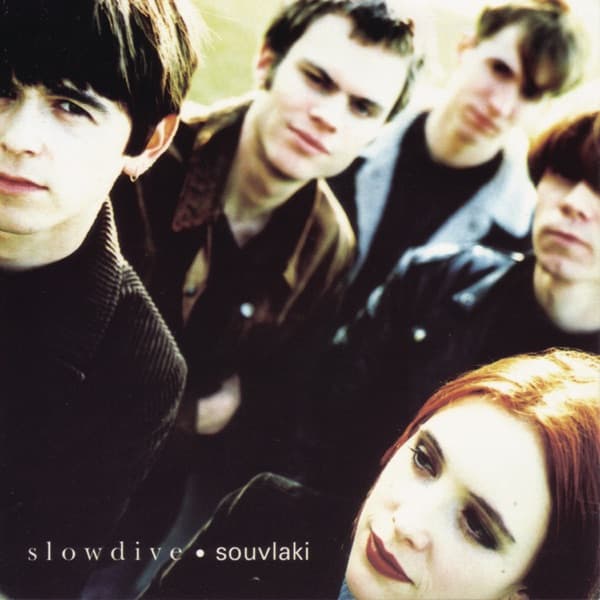

The first thing you notice is how close everyone is. Five people are crammed into the frame of Souvlaki, shoulders overlapping, heads tilted at different angles, as if the camera pushed them into a corner and they simply stopped retreating. Steve Double, credited for the photography, arranges them not as a posed line-up but as a huddle caught mid-stare, and the effect is intimate and slightly uncomfortable, like being spoken to at very close range.
A cold green light bathes everything. It flattens skin tones toward grey and pushes the mood somewhere autumnal and overcast, the sort of daylight that never quite arrives. Against that chill, one detail burns: the red-haired woman anchored in the lower right corner, her hair a warm copper counterweight to all the muted greens and blacks around her. Her eyes are ringed in smudged dark shadow, her lips a deep wine red, and she looks up into the lens from below, the only figure who breaks the horizontal cluster of heads above her.
The four others fan out across the top of the image. On the far left, a young man in a corduroy jacket dominates, his face largest, an earring catching the faint light, his gaze level and unbothered. Behind and between them the other three recede into shadow, one in a leather jacket with the collar up, another half-lost in the dark at the back, a fourth with a heavy fringe of hair at the right edge. Nobody smiles. There's no drama in their expressions, just a shared, guarded stillness that reads less as attitude than as fatigue or patience.
Down in the lower left, in small, spaced, lowercase letters, sits the only text: slowdive and souvlaki, separated by a single dot. The typography is deliberately quiet, thin and unassertive, refusing to compete with the faces. It's the kind of restraint that trusts the photograph to do the work, and it lets the eye travel freely from the corduroy jacket to the copper hair and back.
That unglamorous title, oddly, has a filthy origin. Souvlaki takes its name from a Jerky Boys prank-call skit, in which the caller, discovering that a hotel manager is Greek, delivers a crude punchline built around the word souvlaki. There's nothing on the cover to hint at the joke; the sombre green portrait keeps its secret, which only sharpens the mismatch between the serious faces and the grubby comedy behind the name.
The seriousness on those faces looks almost prophetic when you know how the record was received. Released on 1 June 1993 through Creation Records, it arrived as a Creation product carrying the catalog number CRECD 139, and it landed with a shrug. It peaked at number 51 on the UK Albums Chart and was met with tepid reviews. For a band making dream pop and shoegaze at the moment the British press was turning against that whole world, the muted green light of the sleeve feels almost like foreshadowing.
The rejection had started even earlier, and from inside the house. Creation boss Alan McGee was unimpressed by the band's early Souvlaki material and turned it down. So the guarded expressions in Double's photograph carry an extra charge in hindsight: this is a group being crowded to the front of the picture by a label that wasn't fully convinced, staring out at an audience that wasn't yet listening.
And yet the composition refuses to plead. Nobody in the frame is performing warmth or courting sympathy. The huddle is dignified, almost defensive, the faces offered plainly and left to be judged. That plainness is part of why the cover has aged so well. There are no props, no scenery, no conceptual gimmick, just five people, a green cast of light, and a small line of type, an image confident enough to be quiet.
Time rewrote the verdict. The album that scraped to number 51 and earned lukewarm notices has since gathered retrospective acclaim and is now regarded as a classic of shoegaze, one of the defining statements of the style. The same faces that looked overlooked on release now look like they were simply early, staring out of that cold light at a future that would eventually turn around to meet them.
A word on later editions, because credits can blur. A 2006 reissue lists design by Becky Stewart, but that belongs to the reissue and not to the original 1993 sleeve; the photograph that defines the record, the green-lit huddle of five, is Steve Double's. Keeping that straight matters, because the power of the image lies precisely in its 1993 austerity, in the decision to let a single close, unsmiling group portrait carry the whole weight.
Look one more time and the balance of the frame reveals itself: four faces stacked and shadowed across the top, one lifted copper-haired face glowing in the corner below, a thin lowercase title tucked into the opposite edge, all of it sunk in a green that feels like weather. It's a cover that whispered when it came out and was mostly ignored for whispering. Now the whisper reads as the point.