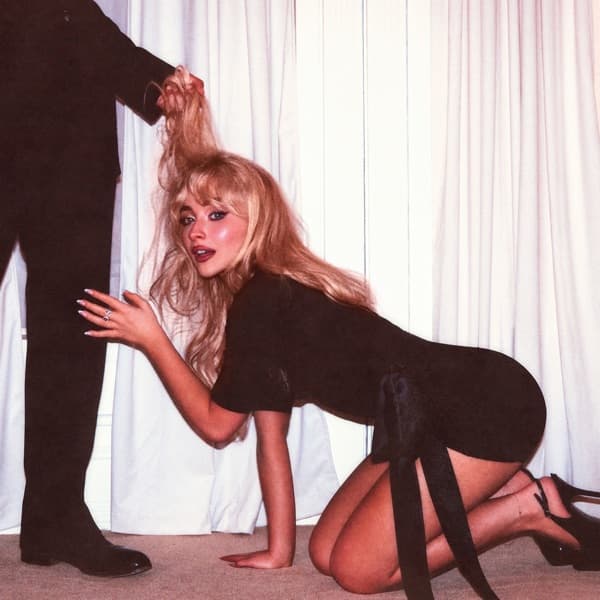
Work through the image and it becomes clear how much of its charge comes from where the eye is forced to travel. It begins at the top, at the fist buried in a heavy curtain of platinum hair, then follows that tension downward along the spine to the floor. The man who owns the hand is deliberately incomplete: a black trouser, a black shoe, a sleeve, cut off by the frame so that he stops being a person and becomes a force acting on the picture. Making him anonymous throws all the weight of the image onto the woman below.
Carpenter is on a carpeted floor in a short black minidress with a ribbon tie trailing down her back, sheer stockings, and black heels that catch the light at the far right edge. Her hair is teased big at the crown and falls in a single heavy sweep over one shoulder. One hand presses flat against the man's trouser leg, steadying her, and her face turns up toward the lens. Everything about her posture reads submission; everything about her expression declines it. That contradiction is the engine of the composition. She looks knowing rather than hurt, level rather than pleading.
The setting is almost domestic in its plainness. Floor-length white drapery fills the background, softly rumpled, catching a warm interior light. The palette runs from that creamy white through the beige carpet to the deep blacks of the dress, the suit, and the shoes, a tight three-note scheme that keeps the eye moving between the pale ground and the dark figures. The grain and glow of film give it a lived-in warmth that stops the image feeling clinical, closer to a candid interior than a studio shot.
Read as a whole, the cover stages the posture of submission carrying a face that refuses it, and it wants you to notice the gap. Carpenter framed the concept as being "in on the control, being in on your lack of control, and when you want to be in control," the awareness a young woman has of the exact moments she holds power and the moments she does not. The title turns the same screw, and a separate promotional image pushed the joke all the way, showing a dog wearing a collar stamped with the album name. Placed against the woman on all fours, the pun is impossible to miss and impossible to take entirely straight. The strength of the image is that it never resolves: it offers a picture designed to look like degradation and hands the viewer a face that quietly insists otherwise, leaving the meaning to be fought over rather than delivered.