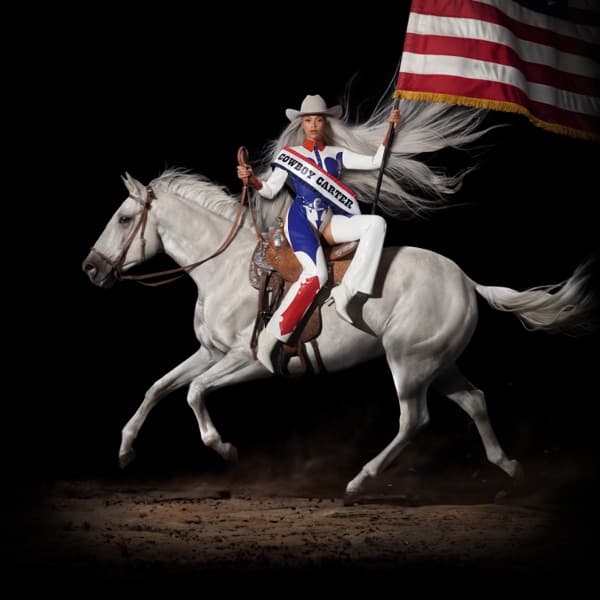
Your eye lands first on the horse because it fills the frame, and only then travels up to the woman balanced on its back. The black surround does the work: with no landscape, no arena and no crowd, the whites and reds and blues have nothing to compete with, so the palette detonates against the void. The spotlit stallion mid-stride, mane and tail streaming, reads as motion frozen at its peak, the entire scene surging forward while the rider stays serene.
Her outfit is a study in red, white and blue: white sleeves and white trousers, a torso panel that runs through blue and red like a flag redrawn onto the body. The sash lettered COWBOY CARTER is not an accident of styling. It deliberately echoes the culture of rodeo queens, the women who win titles at pageants like Miss Rodeo Texas and then ride wearing named sashes and cowboy hats. Read that way, Beyoncé is crowning herself, staging her own coronation as a rodeo queen without a pageant to grant the title.
The composition speaks fluently in a language of power that predates any of us. Stately equestrian portraits of George Washington and Napoleon place a leader on a rearing or striding horse, and this image summons that lineage on sight, a commander on horseback advancing with a banner. Critics reached specifically for Jacques-Louis David's Napoleon Crossing the Alps, and for the paintings of Kehinde Wiley, who places Black subjects in lavish settings that reference Western masterworks once reserved for white leaders. Artnet News noted that the mounted, flag-raising scene evokes the banner Marina Abramović holds in her work The Hero.
But the image also points somewhere else entirely: to the legacy of Black cowboys and to the Bill Pickett Invitational Rodeo, a history that mainstream country iconography has tended to erase, and to figures from the Prairie View Trail Riders of Texas to contemporary Black rodeo queens such as Khalilah Smith. The picture asks you to hold both references at once, the general and the rodeo rider.
The cover also rhymes with Beyoncé's own past. It echoes the equestrian theme of the 2022 Renaissance cover shot by Carlijn Jacobs, an image itself compared to John Collier's 1898 painting Lady Godiva. Seen side by side, the two albums form a diptych of a woman on a horse, one glittering and mirrored, the other charging through darkness under a flag. The red, white and blue scheme carries across the whole rollout, so the flag palette becomes a thread running through the entire project rather than a single stunt.
What began as a picture flooded with comparisons is finally an image of its own making: a woman riding out of the dark, hair and flag streaming, everything staged so that composure and force occupy the same frame.