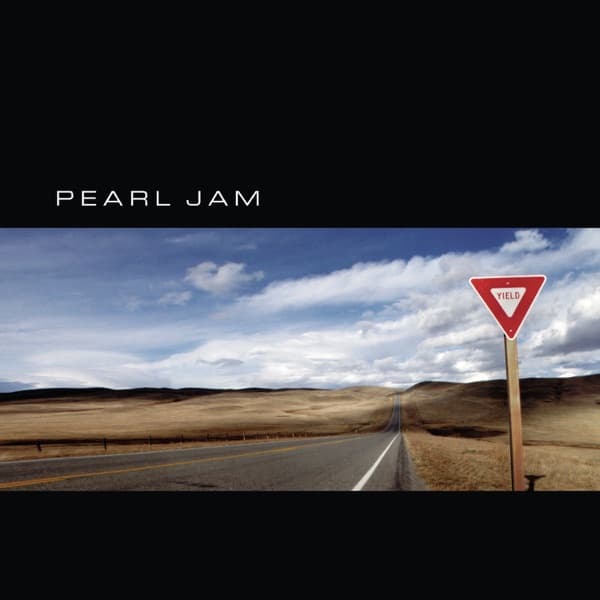
Read choice by choice, the picture is almost aggressively simple, and that is the point. The horizon sits low, pushing the sky into the upper half of the frame so the weather does most of the emotional labor. Those towering cumulus clouds feel charged, half promise and half warning, deep blue crowded with light. Beneath them the land is dry and gold, empty of cars, buildings, or people, which lends the scene a stillness that edges into loneliness.
The composition routes the eye with real control. The two-lane blacktop, its yellow center line and white shoulder stripe converging, pulls the gaze deep into the distance and out toward the hills. But the focal path never quite escapes, because the YIELD sign anchors the right edge and holds. Its saturated red is the only strong color in a scene of muted browns and blues, so while everything else recedes, that small triangle refuses to. The tension between the receding road and the insistent sign is what gives the image its pressure.
The typography stays out of the road's way. The band name, PEARL JAM, sits in the upper left in clean, widely spaced sans-serif letters laid over a solid black band that caps the top of the sleeve. That black bar frames the sky like a letterbox, and the restrained white lettering never competes with the image below it. There is no clutter, no song titles, no fuss. The photograph is allowed to be the argument.
Then the argument turns. The exterior is a die-cut cover, with the YIELD sign printed on the inner colored sleeve so it shows through the front. Open the CD and the whole bright, dry landscape transforms: the same highway lies submerged under water, an apocalyptic flooding of the road you had just been traveling. The sunlit calm gives way to something drowned and ominous, and it reframes the front entirely. That empty road you were invited down leads somewhere underwater, and the serenity of the cover suddenly carries a hidden undertow.
What does the whole image mean? Set against the moment, the traffic sign is a confession and a resolution at once. Yield. Give way. It was widely read as the band saying, at last, that it was throwing in the towel on its long fight, softening its hardline stances and putting the focus back on the music. The surface reads like surrender and forward motion together: keep driving, but stop fighting the road. And the flooded interior complicates that peace, hinting that the water is already rising over the road behind you. The power of the cover is how much it says with so little. No portrait of the band, no drama, just a road, a sky, and a sign, and the single instruction they all point toward.