In the Aeroplane Over the Sea
Neutral Milk Hotel · 1998
- Designer
- Chris Bilheimer
- Label
- Merge Records
- Decade
- 1990s
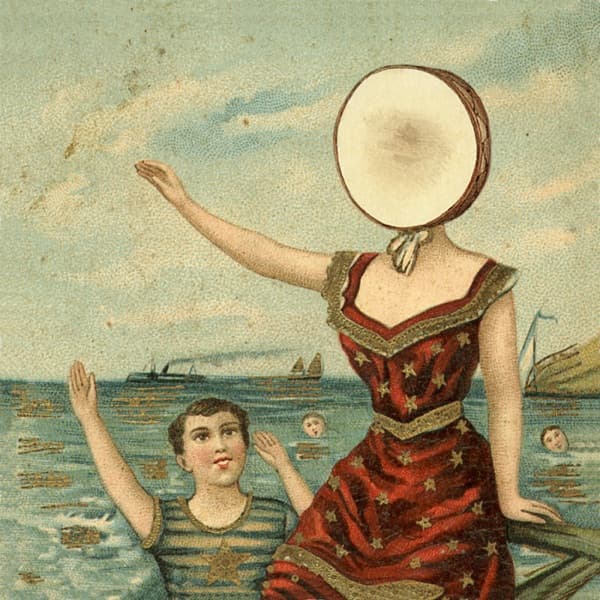
The cover of Neutral Milk Hotel's 1998 album looks like it was discovered in an attic trunk rather than designed in a studio. The image combines a vintage photograph of a woman's body in a one-piece bathing suit with the head replaced by a large drum or tambourine, creating a collage that has the disquieting quality of a Joseph Cornell box or a Max Ernst photomontage. The art was created by the band's frontman Jeff Mangum in collaboration with graphic designer Chris Bilheimer, who helped realize the lo-fi, handmade aesthetic that the band's visual identity demanded.
The vintage photograph that forms the body of the figure is a real found image, a snapshot from an earlier decade whose warm, sepia-toned quality places it in the mid-twentieth century without being precisely datable. The woman stands on what appears to be a beach or waterfront, her posture relaxed and natural, creating a base image that reads as innocent and domestic. The replacement of her head with a round, flat object, variously interpreted as a drum, a tambourine, or an abstracted face, transforms this ordinary snapshot into something surreal and faintly disturbing.
The collage technique is deliberately rough, with visible edges where the drum element meets the body, making no attempt to create a seamless composite. This roughness is essential to the image's meaning: it signals that the world depicted is one where things do not fit together properly, where the human and the mechanical, the organic and the manufactured, have been joined in a union that is visible rather than hidden. The crudeness of the technique communicates authenticity in the same way that the album's lo-fi recording quality does: by refusing polish, it insists on emotional honesty.
The color palette is limited to the warm sepia and amber tones of aged photographic paper, with the off-white of the sky and the deeper browns of the figure creating a narrow tonal range that gives the image its unified, antique quality. There are no bright colors, no modern hues, nothing that anchors the image in the present day. This deliberate pastness is consistent with the album's lyrical preoccupations, which include Anne Frank, childhood memories, religious imagery, and the ache of loss across time.
The composition is centered and frontal, the figure standing upright in the middle of the frame with the horizon line visible behind, creating a portrait-like structure that the headless body simultaneously fulfills and disrupts. The viewer's eye is drawn to the drum-head where the face should be, searching for features that are not there, creating a visual experience of absence and yearning that mirrors the album's emotional core. The figure's arms hang naturally at its sides, and its posture is relaxed, as though unaware that its head has been replaced, adding a note of surreal normalcy.
The typography uses a hand-drawn or irregularly set font for the band name and album title, maintaining the handmade quality of the collage artwork. The letters have the slight wobble of a rubber stamp or a stencil, reinforcing the fanzine aesthetic that permeates the album's visual identity. The text is positioned at the top of the image, creating a banner-like effect that frames the figure below with the formality of a carnival sideshow poster.
The inner artwork extends the collage aesthetic with additional found images, hand-drawn illustrations, and layered textures that create a visual world as densely referential and emotionally charged as the music. The booklet feels like a personal journal or an outsider art project, filled with images that resist easy interpretation but communicate a consistent emotional frequency of wonder, grief, and transcendence.
In the Aeroplane Over the Sea's cover has become one of the most beloved and parodied images in independent music, its drum-headed figure a symbol of the album's cult following and its particular emotional territory. The image's power lies in its combination of warmth and strangeness: it invites intimacy while maintaining mystery, welcomes the viewer into a world that operates by its own logic, and communicates the album's central emotion, a love so intense it crosses the boundary between life and death, in a single, haunting frame.
Get notified when we publish new cover stories. Download the Behind the Covers app and turn on notifications — a new album art deep dive, every day.
Loved the story behind In the Aeroplane Over the Sea? Hear the album or add it to your collection.
More Rock Covers
More from the 1990s
Want to explore more?
Never miss a new cover story
Get the Behind the Covers app and turn on notifications — we publish new album art deep dives every day.