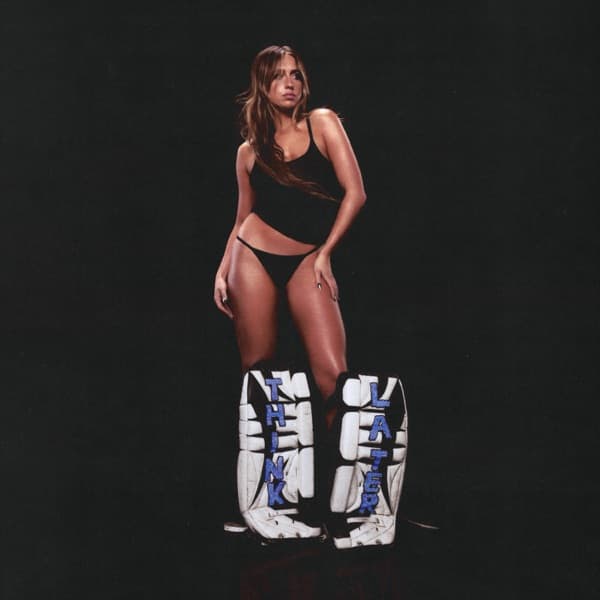
The composition runs on a single vertical axis. McRae's body forms the top two-thirds of the frame, the goalie pads the bottom third, and the eye travels down her from the tilted, faraway gaze to the painted lettering at her feet. Because the pads carry the only text and nearly the only bright value, they act as the true focal point, arresting the downward glance before it can leave the frame.
The tonal scheme is deliberately narrow. A stark black background erases any setting, so there is no room, no floor line, no context beyond the figure and her gear. That negative space does two jobs: it isolates the white goalie pads as the brightest object in the picture, and it flatters the warm, lit skin of the figure so the body reads as sculptural against the dark. Light falls only where it matters, on McRae and on the equipment.
Colour is rationed to a single note. The blue of THINK LATER is the lone chromatic accent, and its placement across the white pads, which themselves carry black trim, ties the palette back to the black surround. The result is a clean, athletic aesthetic rather than a conventional pop glamour shot, an effect that speaks at once to McRae's dance background and to a hockey-centric hometown.
The typography reinforces that directness. THINK LATER is set in a bold sans-serif, its plainness matching the blunt imperative of the phrase. Crucially, the type is not laid over the image as a separate graphic layer; it is painted onto the pads themselves, so the sporting equipment becomes the literal canvas for the album's identity. Word and object fuse, which is why the design reads as integrated rather than captioned.
The figure and the gear are set in tension by design, the stark simplicity of the hockey equipment weighed against the title treatment. She wears minimal black, the pads are oversized and utilitarian, and the pairing is what gives the frame its charge: a young woman standing over the symbols of her heritage rather than performing a standard pop pose.
Read whole, the image argues that identity can be worn on the body as openly as the words are worn on the pads. The minimalism is not emptiness but focus, forcing the viewer to reckon with the one unlikely detail the artist chose to stand on. It works because the metaphor is legible at a glance and yet loaded: the escape she once wanted is replaced by ownership, and the picture stages that reversal without a single explanatory line beyond two painted words.