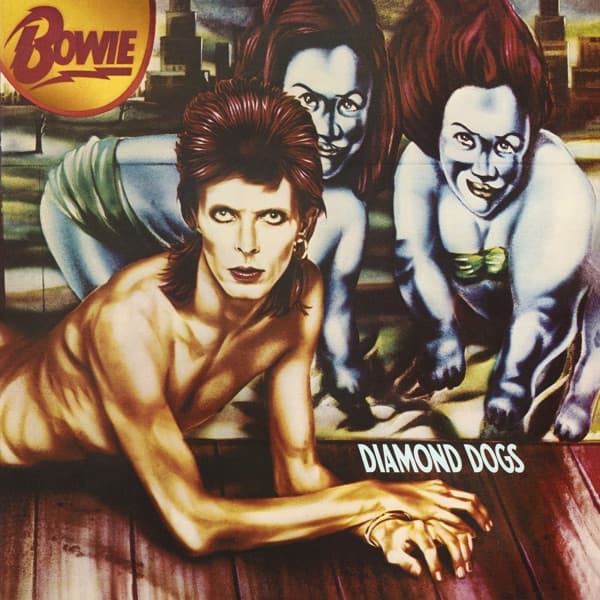





The thing that stops your eye is the body. A lean, tanned torso ends where it should not: at the haunches and hind legs of a dog, splayed across rough wooden boards. The face on top is unmistakably David Bowie, copper hair raked back, one gold hoop in his ear, eyes painted to hold yours with a cool, slightly feral steadiness. He props himself on one arm, the other hand resting flat, and the seam where man becomes animal is rendered so smoothly that the illusion almost holds.

This is Diamond Dogs, the cover that Belgian artist Guy Peellaert painted for David Bowie in 1974. Bowie had handed his earlier cover photographers a wide berth after Peellaert's catalogue Rock Dreams, with its airbrushed and exploited photographs, kept climbing in popularity. He wanted that same glossy, dreamlike menace, stylistically close to the work Peellaert was producing for the Rolling Stones' It's Only Rock 'n Roll.

There was mischief baked into the commission. Bowie, friend and rival to Mick Jagger, went behind Jagger's back to cajole Peellaert into doing his cover too, knowing Diamond Dogs would land about five months ahead of the new Stones record. Peellaert later said Bowie 'tricked me into doing the cover artwork,' only floating the idea of a painting once they were already at the session, an idea too interesting to refuse.

That session belonged to photographer Terry O'Neill, whose reference photos became the painting's skeleton. Bowie posed as a dog, a Great Dane brought along to the shoot, and the pose itself was lifted from a 1926 photograph of Josephine Baker. Peellaert then fused Bowie's body with the legs of a whippet and dressed the scene in freak-show detail.

Look past Bowie and the carnival reveals itself. Behind him crouch two creatures with the same hybrid logic: human faces, dark red hair, pale blue-grey doglike bodies, grinning out from the shadows. One wears a small green bow at the throat. These two are based on Coney Island Cavalcade Variety Show performers, Alzoria Lewis, billed as 'the Turtle Girl,' and Johanna Dickens, 'the Bear Girl.' The smoky industrial skyline and pleasure-park backdrop came from a book Peellaert owned about Coney Island's Pleasure Park, all greens, browns and chimney haze.

The typography keeps things almost playful against the strangeness. Top left, a sunburst orange and red disc holds the word Bowie in fat scarlet letters, a lightning bolt slashing through the O. Lower right, in cool airbrushed blue capitals, sits the title Diamond Dogs. The palette splits the image: warm gold flesh and red hair in front, cold blue freaks behind.

What you cannot see is exactly the point. The full gatefold version showed the hybrid's genitalia, and RCA Records had them airbrushed out for most pressings. A handful of uncensored copies slipped into circulation, and according to Goldmine price guides those rare sleeves became among the most expensive record collectibles ever, changing hands for thousands of dollars apiece. Guy Peellaert, who lived from 1934 to 2008, left behind a cover where the censor's brush only deepened the legend, and where a pop star, a whippet, a Great Dane and two sideshow performers stare out from a painted Coney Island that never quite existed.