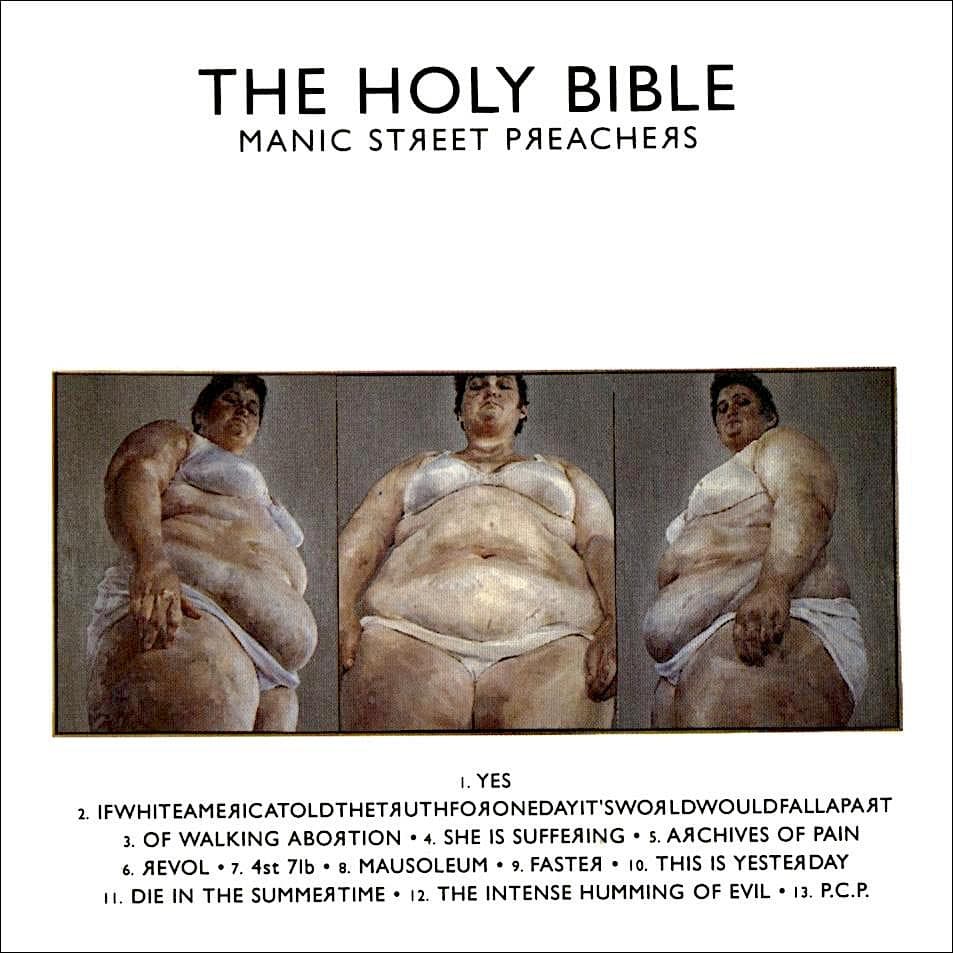

The cover of The Holy Bible does not ease the listener into the record. It confronts them before the first song begins. Three painted views of the same body fill the sleeve: a woman in underwear, seen from different angles, her flesh pressed forward with none of the distance or polish normally associated with a rock album cover. The work is Jenny Saville's Strategy (South Face / Front Face / North Face), and in 1994 it was still startlingly new.
Richey Edwards and Nicky Wire were drawn to Saville's work because it challenged conventional ideas of beauty. Years later, the band described the choice in terms of finding beauty inside what society was inclined to call ugly. That was not an incidental fit. The Holy Bible is preoccupied with bodies under pressure: anorexia, self-image, political violence, punishment, exploitation and the ways institutions turn human beings into objects. Saville's painting gave those themes a physical presence without illustrating any single lyric.
Edwards met Saville and talked her through the songs and the ideas behind the record. According to accounts repeated by the band and later retrospectives, she allowed the group to use Strategy without charging a licensing fee. The choice gave the sleeve the weight of contemporary fine art rather than conventional music photography, and it immediately separated the record from the dominant visual language of mid-1990s British rock.
The rest of the package extended that severity. The back cover used a photograph of the band in military clothing, later painted over by Barry Kamen, while the sleeve incorporated a quotation from Octave Mirbeau's The Torture Garden. Neil Cooper supplied sleeve photography. The visual world surrounding the record was therefore not one image but a dense collage of art, military imagery, quotation and documentary material.
The typography also became part of the band's identity. The stark lettering, including the reversed R motif associated with this period, would echo through later Manic Street Preachers artwork. Yet the Saville painting remains the dominant memory of the sleeve because it refuses the basic promise of most album covers: that the image will make the artist, or the record, easier to consume.
Instead, it asks the viewer to sit with discomfort. That was exactly what The Holy Bible asked of its listeners.