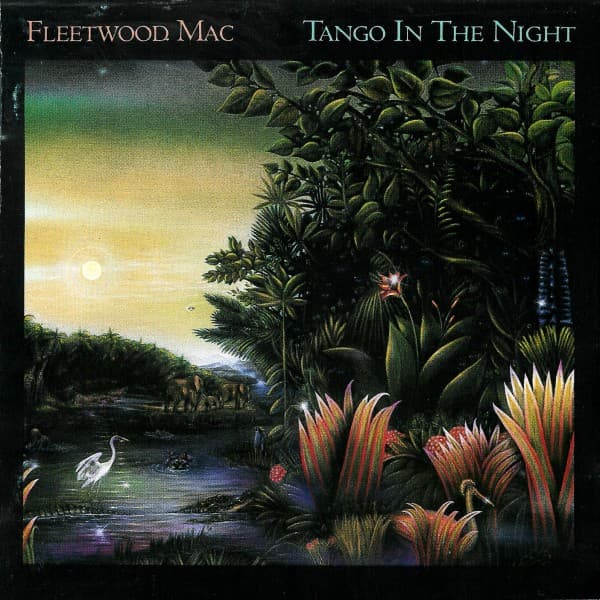




The cover of Tango in the Night looks less like a rock sleeve than a remembered dream. A dark jungle opens around a strip of water. Leaves crowd the foreground, birds stand almost motionless, and small animals seem to disappear into the vegetation. Above it all, the sky glows with a theatrical blue light that makes the scene feel suspended somewhere between night and fantasy.
The image was not commissioned from scratch for Fleetwood Mac. The painting, Homage à Henri Rousseau, was by Australian artist Brett-Livingstone Strong and was already hanging in Lindsey Buckingham's home. Strong built it as a deliberate salute to Henri Rousseau, the French painter whose imagined jungles packed lush plants, animals and strange stillness into flattened, dreamlike spaces. Buckingham and producer Richard Dashut are credited with the cover concept, and the choice of that existing painting turned the album package toward the same nocturnal atmosphere suggested by its title.
The release credits divide the work clearly. Strong made the cover painting. Greg Gorman is credited with the cover photograph, documenting the painting for reproduction. Jeri Heiden handled art direction, while Buckingham and Dashut are credited with the cover concept. The result is a useful reminder that a famous album cover can be the product of several distinct roles even when a single artwork dominates the front.
What makes the sleeve work is the tension between stillness and excess. The jungle is crowded with detail, but almost nothing appears to move. Strong's plants overlap in dense layers; the water reflects the moonlit color; animals are present without becoming the focus. The composition feels lush without becoming chaotic. That visual calm sits against an album whose polished surfaces were created during one of Fleetwood Mac's most strained periods.
The painting also became part of the album's wider visual identity. It was reused for the lead single Big Love, extending the jungle image beyond the LP itself. Decades later, the cover remains one of Fleetwood Mac's most immediately recognizable sleeves precisely because it does not rely on a band portrait. Instead, the record enters through atmosphere: moonlight, foliage and a painted world that seems to exist outside ordinary time.