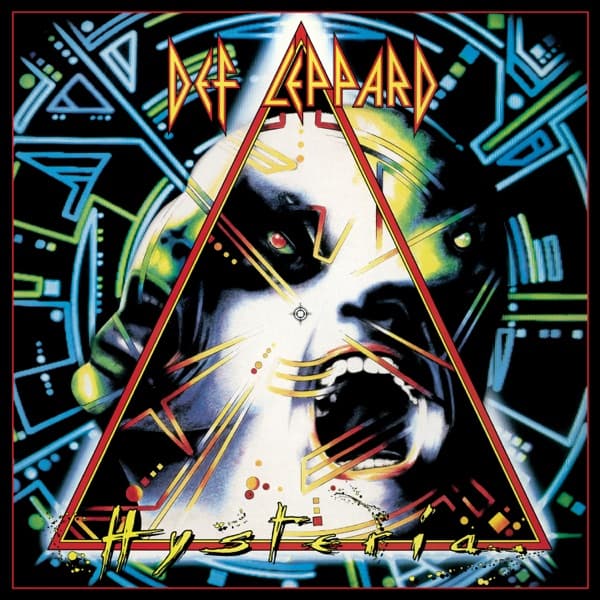
The first thing that reaches you is the scream. Dead center of Hysteria sits a face caught mid-cry, mouth stretched open, one visible eye glowing an unnatural red, its features smeared and pulled until they hover between human and something wilder. It turns to look straight at you, and that turn is the whole trick: it makes the image feel like it noticed you were watching.
The face is boxed inside a sharp red-outlined triangle, Def Leppard's recognisable shape, which designer Andie Airfix used as his starting point. Yellow slashes of light rake across the skin like claw marks or electrical arcs. Behind the triangle, a dense circular mandala of neon blues, greens and hot pinks radiates outward, part circuit board, part tribal carving, a maze of glyphs and angular tracks glowing against pure black. At the top, the band name is rendered in that stacked, jagged silver-and-gold lettering. At the bottom, the word Hysteria loops in a looser, almost handwritten script, splattered like paint.
The man behind all of it was Andie Airfix, working through his Satori studio, credited with the illustration, artwork and design. He got the call in an unusual way. Def Leppard co-manager Peter Mensch had admired Airfix's sleeve for the Thompson Twins' 1985 record 'Here's To Future Days,' and that admiration turned into a job offer.
What Airfix delivered first, though, was a completely different animal. Several of them, in fact. The album was originally going to be called 'Animal Instinct,' and his early sleeve chased that idea literally: an eagle, a lion and a shark blending into one another, predators dissolving into a single form. Then the title changed, and the whole concept had to be scrapped and rebuilt from scratch.
The new title carried real weight. Drummer Rick Allen conceived the name Hysteria, referring to his own car accident, the amputation of his arm, and the storm of worldwide media coverage that followed. A word about a body broken and a world watching gave Airfix a very different emotional target than three merging beasts.
So he kept the animal aspect but bent it toward fear. The distorted, almost-human face is what remains of that instinct concept, an image built to be frightening, to retain something feral while turning to fix its eyes on whoever holds it. You can read the leftover animal DNA in the way the features refuse to settle, in the yellow fur-like shading around the jaw, in the wideness of that howling mouth.
Airfix had an unusual luxury: time. The recording sessions dragged on for what stretched into years, which meant he had roughly two years to fine-tune the design. The band's involvement stayed light, mostly a matter of saying whether they liked an idea or not, leaving him room to obsess over the details of the screaming face, the neon labyrinth, the balance of the triangle against its circular halo.
He used that time to plan something almost nobody buying the record would have noticed at first. Convinced the arriving CD format was about to kill vinyl, Airfix divided the cover image into nine equal segments. Each single released from the album would take one of those segments as its own sleeve, so that if you collected them all and laid them together, the individual covers would assemble into one large mural, roughly three feet across.
Completing that mural became its own long saga. A July 1988 twelve-inch of 'Love Bites' shipped with four extra twelve-inch panels to fill in more of the picture. Even then, two panels stayed missing for decades, until a 2018 Hysteria Singles box set finally supplied cover art for 'Excitable' and 'Love and Affection,' closing the gaps and completing the full image at last.
Hysteria arrived on 3 August 1987 through Mercury Records, a hard rock and glam-metal statement whose sleeve matched the era's appetite for polish and menace in equal measure. The neon circuitry and airbrushed sheen feel utterly of their moment, yet the raw howl at the center keeps it from being merely decorative. The eye lands on the open mouth first, then follows the yellow light lines outward to the eye, then finally clocks the electric mandala pulsing behind everything.
That 2018 box set completion carried a quiet poignancy, because Andie Airfix died in October of that same year. He left behind a body of work far larger than one triangle: he also created artwork for Metallica, Led Zeppelin and Guns N' Roses. But this screaming face, born from a title change and a drummer's ordeal, split into nine secret pieces and finally reassembled three decades later, remains one of the strangest and most deliberate design puzzles ever hidden in plain sight on a record shelf.