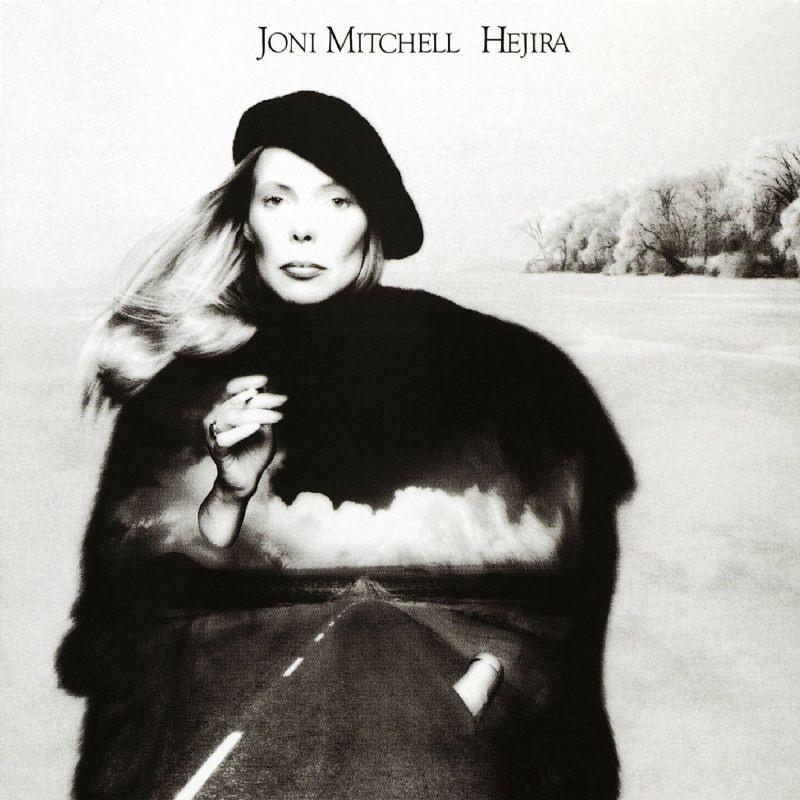

Joni Mitchell's Hejira is an album about motion, distance and the uneasy freedom of being alone. Its cover turns those ideas into an image before the record begins. A black-and-white portrait of Mitchell is combined with a broad landscape, allowing the open road to occupy the same visual space as the singer herself.
Released in 1976, Hejira emerged from a period of travel and reflection. Mitchell's songwriting had already moved far beyond the folk-club settings associated with her early career, and this record pushed further into long, winding melodies and jazz-influenced arrangements. The songs often seem to unfold like thoughts gathered during a drive: one memory leads to another, and the destination is less important than the act of moving.
The cover's photographic treatment is particularly apt for that music. The portrait is intimate, but the landscape pulls the eye outward. Rather than choosing between a picture of the artist and a picture of the road, the design lets the two overlap. It makes travel feel like an interior experience as much as a change of location.
Amelia draws a parallel between the singer's wandering life and the disappearance of aviator Amelia Earhart. Song for Sharon turns a letter to a friend into an extended meditation on marriage, desire and independence. Coyote moves with a restless energy, while Refuge of the Roads finds a different kind of clarity in departure. These are songs about people and places, but also about the stories the traveler tells herself.
The bassist Jaco Pastorius contributed a distinctive sound to several tracks, giving Mitchell's melodies a fluid counterpoint. The arrangements leave space for the words to stretch, double back and find unexpected turns. That openness is echoed by the cover's wide landscape, which offers no obvious endpoint.
The album title comes from a word associated with migration or a journey, and the sleeve makes the idea immediately legible without reducing it to a literal travel photograph. Mitchell's face remains present throughout the composition, as though the changing scenery is inseparable from the person looking at it.
Hejira stands among Mitchell's most compelling unions of music and visual identity. The cover is not merely a portrait of a famous singer or a picture of an American highway. It brings the two together to suggest that a journey can change the way a person sees herself.