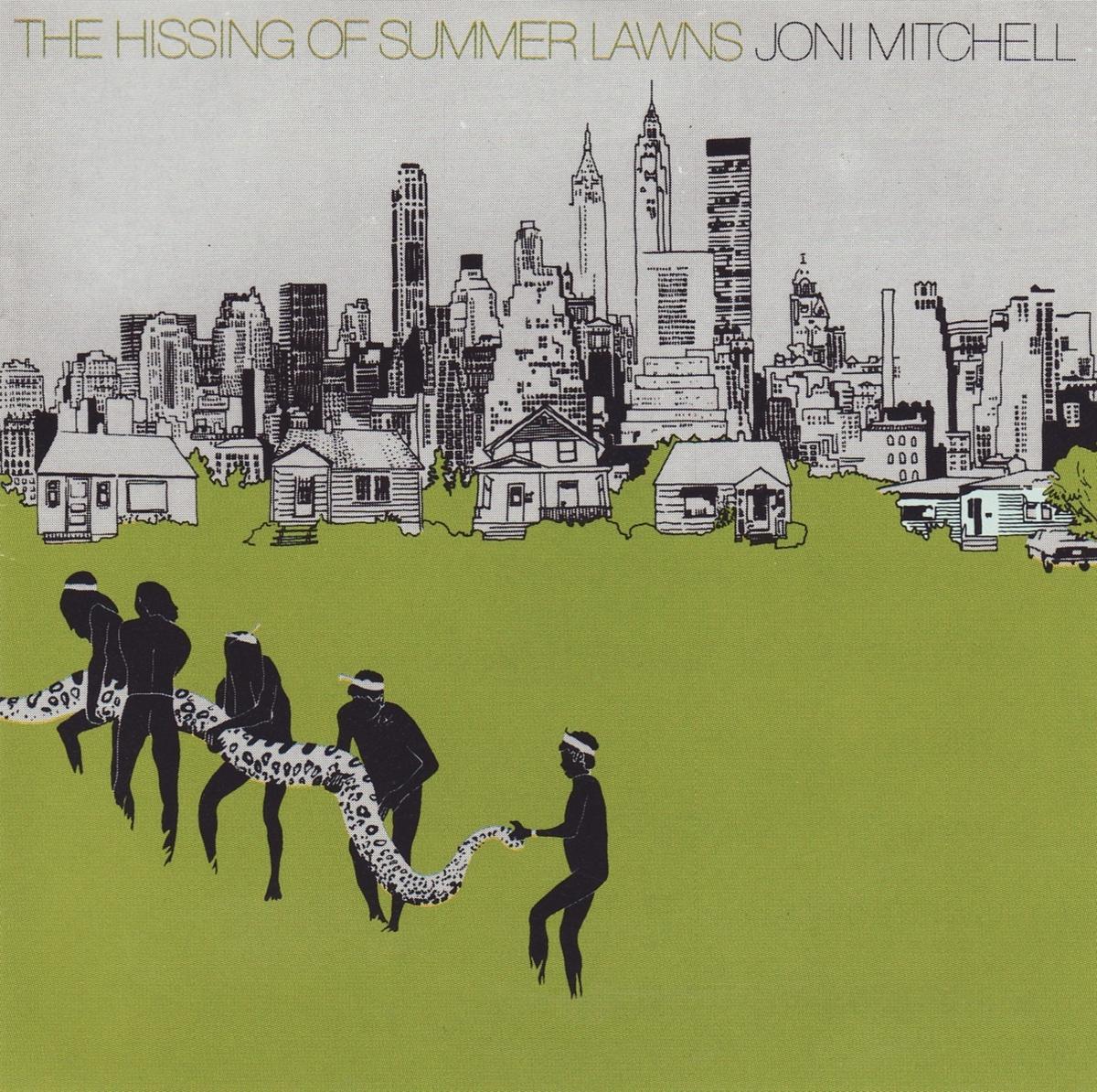




A beautiful lawn ought to be reassuring. On the cover of Joni Mitchell's The Hissing of Summer Lawns, it isn't. A group of figures crosses a wide stretch of green toward a modern house, bringing an unexpected sense of ritual and unease to a scene of suburban comfort. The collision is the point: the landscape looks orderly, but the people moving through it make that order feel strange.
Mitchell created the artwork herself. Long before she was routinely celebrated as a painter as well as a songwriter, she was treating her album sleeves as extensions of the imaginative world of her records. Here the painting opens a door onto the subjects that occupied her in 1975: wealth, social performance, private compromise and the distance between having a comfortable life and feeling free within it.
The title evokes the soft mechanical hiss of lawn sprinklers, a sound of affluent domestic routine. In the title song, a woman's surroundings suggest security even as her life feels circumscribed by the expectations attached to them. The cover makes that tension visible without illustrating a specific lyric. The expansive lawn is both a sign of privilege and an oddly empty stage.
The figures in the foreground interrupt the familiar visual language of the suburban house. Their presence creates a cultural contrast that can be read as satire or dreamlike dislocation. The painting is most interesting when allowed to remain ambiguous: it invites questions about who belongs in this setting and what the setting represents, rather than supplying one neat answer.
The music was equally resistant to easy classification. Mitchell had been moving beyond the singer-songwriter arrangements associated with her early fame, and The Hissing of Summer Lawns pushed further into jazz-inflected textures and experimental rhythm. The Jungle Line, with its striking use of Burundi drumming and synthesizer, still sounds like an abrupt opening into another musical world. Edith and the Kingpin and The Boho Dance explore status and desire through sharply observed characters.
That combination of social observation and musical risk initially unsettled some listeners. Over time, the album has come to be recognized as one of Mitchell's most adventurous works. Its sleeve deserves to be seen in the same light. It isn't simply a picture of a house and lawn; it is a small visual drama about the assumptions we attach to both.
Mitchell's gift was to find tension beneath polished surfaces. On The Hissing of Summer Lawns, she found it in a place designed to look effortless: the perfect green lawn.