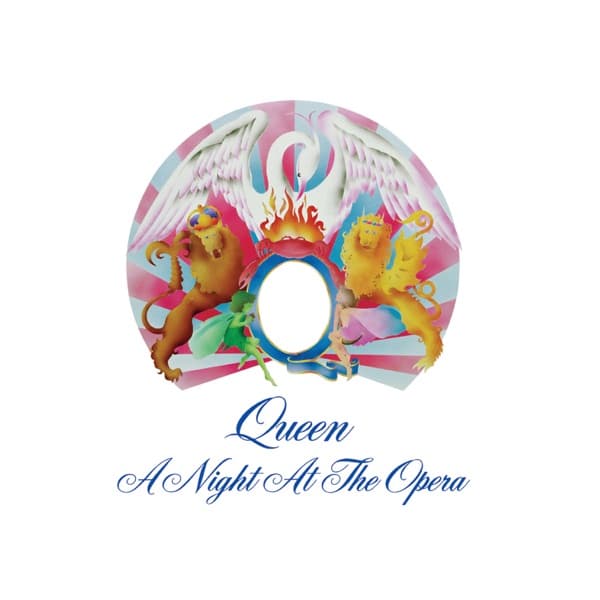
Read the crest slowly and it becomes a secret astrological portrait of four men, each birth sign folded into a single coat of arms. The two golden lions are Leo, standing in for John Deacon and Roger Taylor. A flaming crab perched above the Q is Cancer, for Brian May. And the two fairies, the green one to the left of the Q and the pink-winged one to the right, are Virgo, Freddie Mercury's own sign, doubled. Four members, every horoscope hidden inside a phoenix. Nothing here is decorative for its own sake.
The colour scheme carries the same tension between busy symbol and controlled presentation. The phoenix is white, its feathers tipped in pink and pale blue; the central Q is ringed in blue and orange and appears lit from within by flame. Behind the whole assembly, spokes of rose and sky-blue light radiate outward like sunrays, giving the emblem a sense of emanation, of something glowing rather than merely printed. Flames lick up from the crab and the crowned Q, tying the separate creatures into one continuous event, and the entire arrangement is wrapped inside the spread wings of the phoenix, the way the Royal coat of arms of the United Kingdom gathers its lions and shields under a single crest. The reference is deliberate: British royal heraldry reimagined for a rock band.
The presentation is restrained precisely where the symbol is dense. Everything sits gilded and floating on acres of empty white, with no background scenery to compete. That negative space does real work, isolating the emblem so the eye has nowhere else to go. The focal path is clear: the eye lands first on the bright open Q at the heart, climbs the rays outward to the wings, then drifts down to the title. Below the crest, in flowing royal-blue script, the word Queen sits above the curling letters of A Night at the Opera, the calligraphy as ceremonial and ornate as the heraldry above it, so the type and the image speak the same courtly language.
What the whole image means follows from that single choice to withhold. A conventional rock sleeve of the era would show the players; this one substitutes an invented aristocracy for a photograph, replacing personality with pageantry. The crowned Q, the rearing lions, the resurrecting phoenix all announce permanence and grandeur before a single note plays. The image works because the ornament rewards attention twice: first as a handsome, almost regal design, and then, once decoded, as an intimate group portrait disguised as a coat of arms. It says these four belong on a throne while quietly admitting the throne is made of their own star charts.