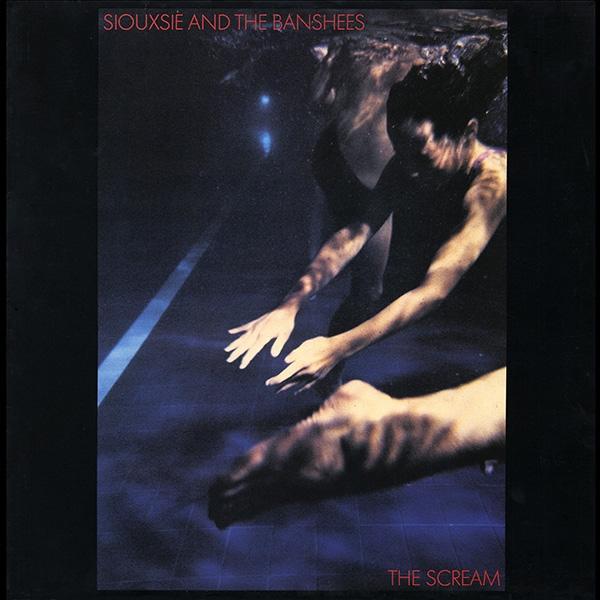

The first thing you notice about the sleeve of The Scream is the blue. A swimming pool, ordinarily a place of bright light and easy movement, has become a strange underwater world. Bodies drift and twist beneath the surface, their outlines broken by the water. Nobody is shown screaming. That is precisely what makes the picture so unsettling.
The idea came from Siouxsie Sioux, who wanted an image that would capture the contradiction at the heart of the title: a scream that cannot be heard underwater. Photographer Paul Wakefield brought the concept to life in a London swimming pool, using underwater equipment and carefully arranged lighting. His recollections of the shoot describe an unpredictable session with young swimmers rather than a meticulously posed band portrait.
Art director Jill Mumford helped shape the finished sleeve. The blue tiles and pale markings give the picture a structure that the moving figures constantly disrupt. It is both recognizably a swimming pool and difficult to read as an ordinary swimming-pool scene. The more closely you look, the less certain you become about what is happening.
The choice was unusually apt for Siouxsie and the Banshees' debut. The group had emerged from London's punk scene, but by the time The Scream appeared on Polydor in 1978, their music was developing a language of its own. John McKay's cutting guitar, Steven Severin's bass and Kenny Morris's drumming create a sense of tension and space around Siouxsie's voice. Songs such as Jigsaw Feeling and Metal Postcard make familiar rock instrumentation feel unfamiliar.
The record also includes an eerie version of the Beatles' Helter Skelter, a useful reminder of how much the band could change the emotional temperature of something listeners already knew. The sleeve performs a similar transformation. It takes an everyday setting and removes its comfort.
There is a cinematic quality to the scene, too. The swimmers seem suspended in a moment without a clear beginning or end. That ambiguity is more powerful than a literal illustration of a scream would have been. Wakefield's photograph asks the viewer to imagine a sound that the image itself seems to swallow.
The Scream reached the UK album chart's top twenty and became an influential early post-punk record. Yet the cover needs no knowledge of that history to work. Almost fifty years later, its strange submerged world still feels immediate: a perfectly ordinary place made frightening by a simple, brilliant change of perspective.