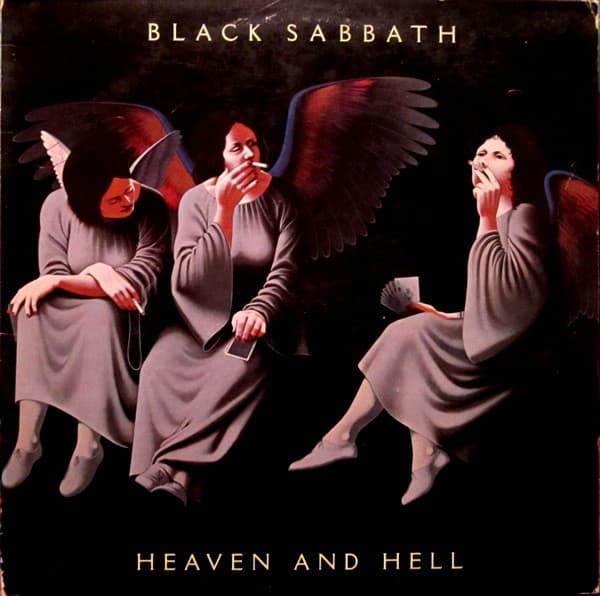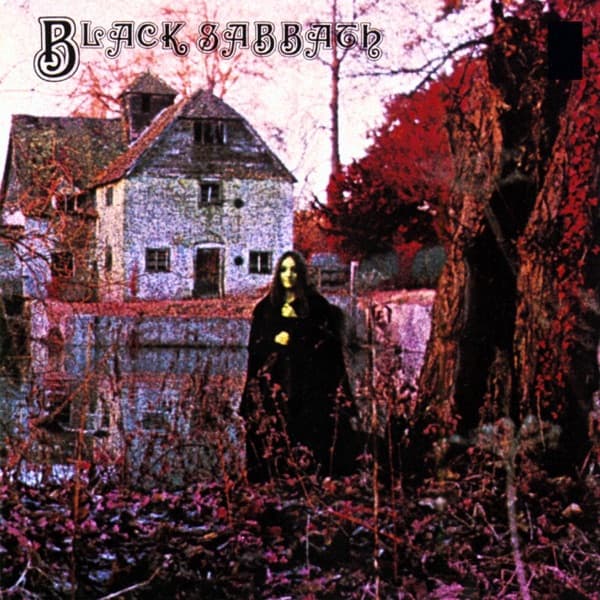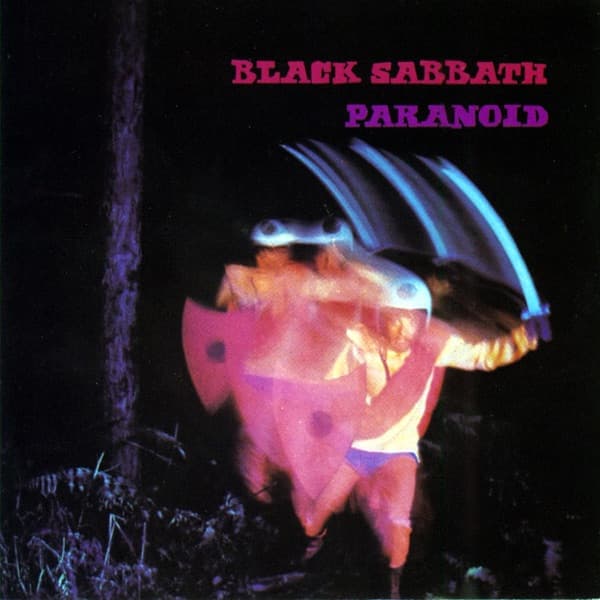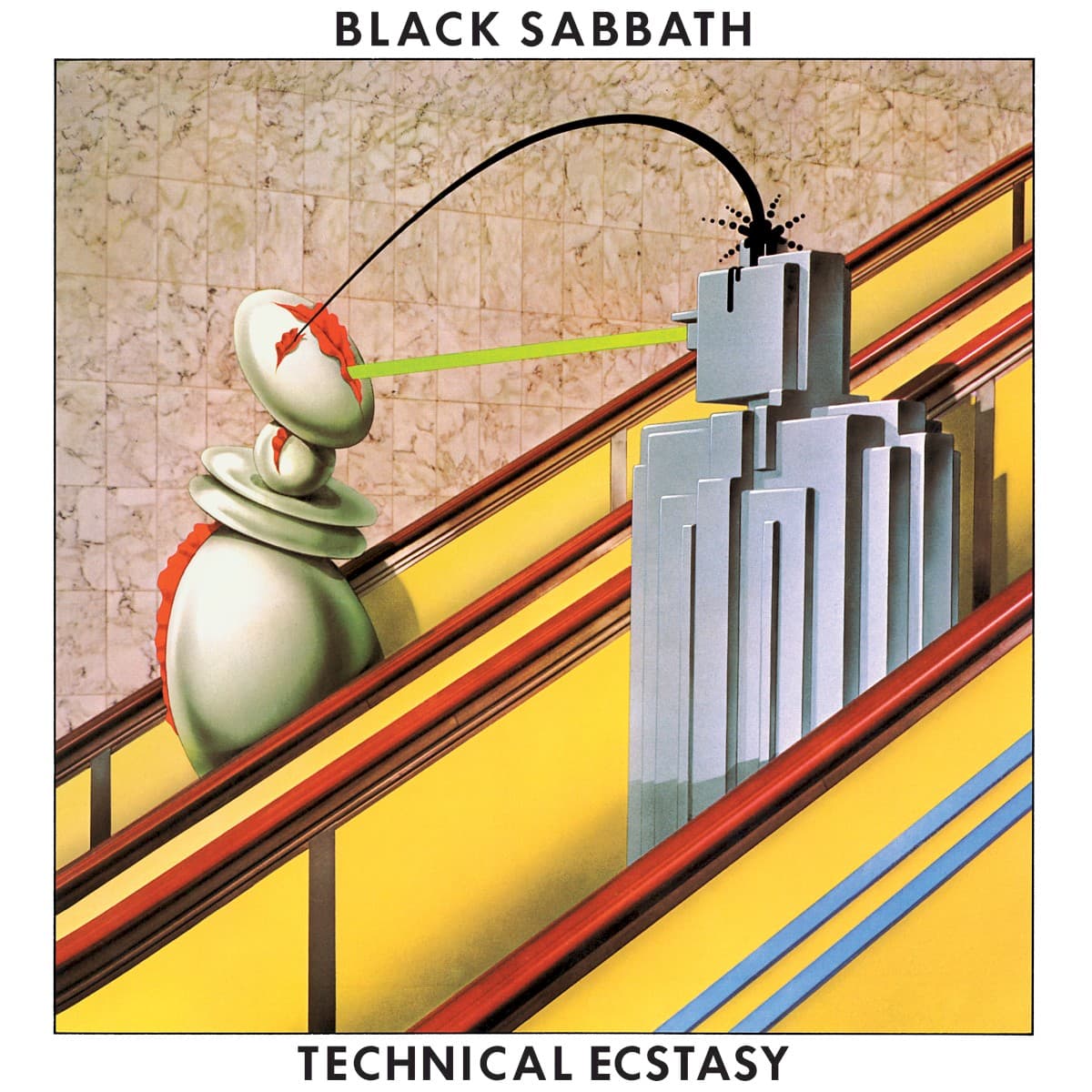


Black Sabbath had spent the first half of the 1970s surrounded by images of darkness: occult typography, graveyard photography, distorted portraiture and stark monochrome. Then Technical Ecstasy arrived looking like a scene from a brightly lit future shopping complex. Two impossible machines ride past each other on escalators. One is rounded and pale, the other tall, angular and metallic. A green line shoots between them. A black arc loops back in the opposite direction. It is funny, sexual, clinical and oddly romantic all at once.
The sleeve came from Hipgnosis, the London design studio that had already made surreal album packaging into a visual language of its own. Storm Thorgerson later explained that the title itself drove the idea. Rather than illustrate Black Sabbath's music literally, he worked from the tension inside the words Technical Ecstasy: something mechanical experiencing something intensely human. His solution was a fleeting encounter between two robots passing on escalators in opposite directions. Instead of human intimacy, the machines exchange lubricating fluid or beams of light.
The concept became more specific in George Hardie's hands. Hardie designed the two robot forms around deliberately exaggerated gender coding: the female figure is built from curves and soft rounded masses, while the male figure is all vertical blocks and hard edges. Thorgerson later acknowledged how stereotyped that visual shorthand was. That admission matters because the cover is not simply a mysterious pair of abstract sculptures. Its visual joke depends on the viewer reading the two shapes as bodies before realizing how little they resemble bodies at all.
Richard Manning, who worked extensively with Hipgnosis, has described the production process in unusually concrete detail. He received a dye-transfer photograph of escalators with glass sides, plus a tracing and position guide for Hardie's robots. Manning transferred the shapes into the image, bleached selected areas, washed color into the escalator sides, airbrushed tonal changes and built soft shadows so the machines appeared to occupy the photographed space. The finished sleeve therefore sits between photography, illustration, graphic design and physical darkroom manipulation.
The individual credits are worth preserving. Contemporary and retrospective Hipgnosis documentation identifies the sleeve as a Hipgnosis design, credits George Hardie with the robot design and graphics, and Richard Manning with the robot drawing or illustration. Flattening all of that into a single 'designed by' name misses how the image was actually made. Hipgnosis supplied the conceptual and art-direction framework; Hardie turned the idea into forms; Manning integrated those forms into the escalator image.
The setting is as important as the robots. Escalators are machines designed to keep strangers moving past one another. Nobody stops. The two figures meet at precisely the point where their paths cross and then continue in opposite directions. That makes the image work as more than a visual gag. The machinery creates the romance and prevents it from lasting. The bright commercial architecture also pushes against the visual expectations attached to Black Sabbath. There are no crosses, graveyards or demonic figures here. The sleeve is clean, modern and almost cheerful, even while its central joke is bizarre.
That break fits the record. Technical Ecstasy was recorded in 1976 as Black Sabbath widened its musical palette with more prominent keyboards, melodic passages and the Bill Ward-sung 'It's Alright.' Tony Iommi's official album history describes the record as a deliberate move toward melodic experimentation and progressive textures. The cover does something similar visually: it refuses to repeat the band's established horror imagery and instead gives them a glossy piece of conceptual design.
Fifty years later, the sleeve still feels unusually legible. You can understand the setup in seconds, but the production history gets richer the closer you look. It is a classic Hipgnosis trick: begin with a simple impossible proposition, then execute it with enough craft that the viewer starts treating the impossible world as normal.