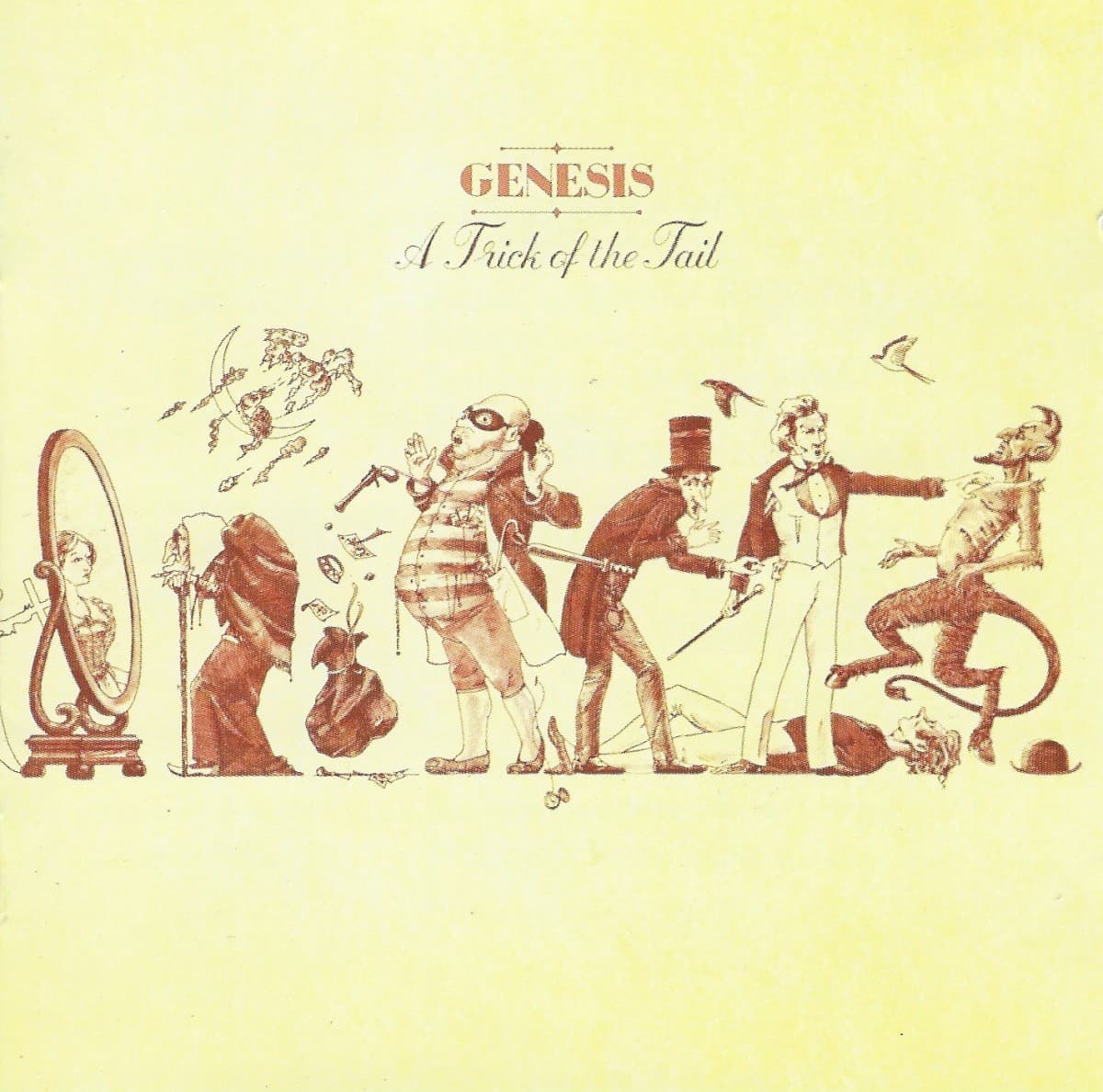
When Genesis began making A Trick of the Tail, Peter Gabriel was gone and almost everything about the band's future seemed open to question. The sleeve answered one of those questions before the needle ever touched the record: Genesis could still look like Genesis.
Across a pale, parchment-like field, illustrator Colin Elgie assembled a procession of odd characters who seem to have wandered out of a Victorian storybook. There is the pathetic Squonk, the criminal world of Robbery, Assault and Battery, the nurse suggested by Entangled, and the strange horned creature at the center of the title song. Rather than illustrating one grand concept, the cover gathers the album's separate stories into a shared cast.
The remarkable part is how little Elgie initially had to work with. Looking back during the album's 50th-anniversary year, he recalled beginning with an unusually vague brief, without finished music or lyrics and before meeting the band. Working through Hipgnosis, he developed the characters from the song ideas he was given and built a visual language that felt literary, theatrical and deliberately old-fashioned.
That approach was unusual for Hipgnosis. The studio was famous for photographic puzzles and surreal constructions, but A Trick of the Tail depends on drawing, empty space and the warmth of brown ink against a light ground. Elgie's illustrations do not overwhelm the sleeve. They invite inspection.
The idea continues inside the gatefold, where characters reappear beside the lyrics and the package turns into something close to an illustrated book. That matters because the record itself is not a single narrative. The artwork supplies the unity: eight songs become chapters inhabited by figures who seem to belong to the same peculiar world.
For an album carrying the enormous burden of being the first Genesis studio record after Gabriel's departure, the sleeve did not announce a rupture. It quietly preserved the band's taste for stories, characters and English eccentricity while giving the new four-piece era an identity of its own.