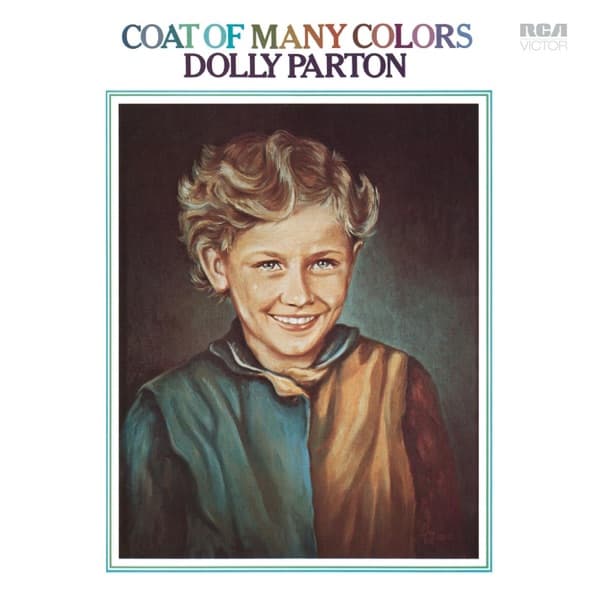
The child on this cover is smiling, but look closer at the eyes. They catch the light in a way that reads as brimming, maybe about to spill. That tension between a bright, gap-free grin and a gaze that seems to hold something back is the whole story of Coat of Many Colors compressed into one painted face.
The portrait shows a young child with a tousled crop of dirty-blond hair, painted against a shadowy brown-green backdrop that fades to near-black at the edges. The lighting falls warm on the left side of the face and leaves the right in soft shadow. But the eye doesn't rest on the face for long. It slides down to the coat, which is the reason this image exists at all: a garment split vertically into two blocks of color, a cool teal-blue panel on one shoulder and a warm ochre-rust panel on the other, with a scrap of fabric knotted loosely at the throat like a makeshift collar.
This is a painting, not a photograph, though it began as one. The source was a childhood school photo of Dolly Parton wearing the patchwork coat her mother sewed for her out of rags. By her own account, the photo was taken the very same day she was teased at school about that coat, the exact event that would later become the title song. Someone rendered that snapshot in oils for the sleeve, softening the schoolroom stiffness into something painterly and warm. The identity of the painter isn't clearly known.
What is known is who photographed the finished painting for the record jacket: Les Leverett, the longtime Grand Ole Opry photographer. His job here wasn't to shoot Dolly at all but to capture a canvas, turning a hand-painted portrait into a printable cover image. It's a quiet, unusual credit, a photographer documenting a painting of a photograph.
The typography keeps out of the coat's way. Across the top, COAT OF MANY COLORS is set in clean capitals, and the letters themselves are tinted in a rainbow sequence, echoing the patchwork theme without shouting it. Below, DOLLY PARTON runs in the same tidy style. In the upper right corner sits the RCA Victor logo, the label that put the album out. A thin double border, teal on the inside, frames the whole portrait like a picture on a wall, reinforcing the sense that you are looking at a hung painting rather than a candid image.
The song behind the cover has its own remarkable origin. Parton wrote it in 1969 on a tour bus, scribbling the words on the back of a dry-cleaning receipt for one of Porter Wagoner's suits. When the song became a hit, Wagoner had that receipt framed, and it now hangs at Dollywood. The lyric tells how her mother stitched a coat from rags and, as she sewed, told the biblical story of Joseph and his coat of many colors, so that the child wore it proudly to school, only to be teased by classmates who saw rags where she saw riches.
That is exactly the emotional charge the painting carries. The two-tone coat, blue and rust rather than a literal riot of patches, still reads as pieced-together and homemade. The child's smile is offered up to the viewer with total openness, which makes the shadowed, glistening eyes all the more poignant. Knowing the photo was taken on the day of the teasing, the composition becomes a small held breath, pride and hurt sharing one face.
Coat of Many Colors arrived on October 4, 1971, on RCA Victor, a country record built around one of the most personal stories in the genre. The cover's refusal to use a standard artist portrait, choosing instead a painted memory of childhood poverty, was itself a bold framing for an album by a rising star.
The recognition that followed dwarfs the humble image on the front. The album landed on Time magazine's list of the 100 Greatest Albums of All Time, and it ranked number 257 on Rolling Stone's 2020 list of the 500 Greatest Albums of All Time. The recording was inducted into the Library of Congress National Recording Registry, and in 2019 it entered the Grammy Hall of Fame. Few records that open with a child's schoolyard humiliation end up so thoroughly enshrined.
The artifacts have outlived the sting too. A replica of the coat that Parton's mother made, along with the original lyric papers, is displayed at her Chasing Rainbows Museum at Dollywood, sitting near that framed dry-cleaning receipt. What was once a source of shame became a shrine, and the painted coat on this sleeve is where that transformation was first made public.
So the cover works on two levels at once. As an object it is modest: a warm oil portrait of a smiling child in a two-color coat, tidy rainbow lettering, a thin frame, a label mark in the corner. As a piece of storytelling it is unusually loaded, a face that was captured on the worst day and then painted, printed, and canonized as a symbol of dignity stitched from rags. The eye lands on the smile, then the coat, then those bright eyes, and the whole small history of the song opens up right there.