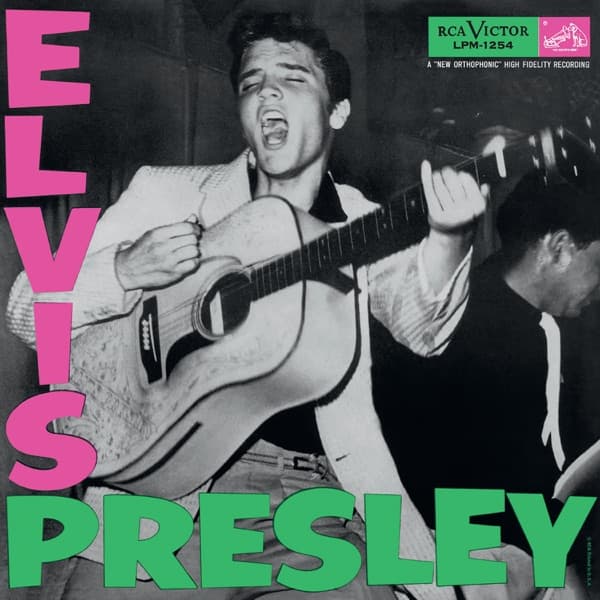
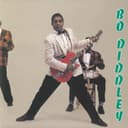
His mouth is wide open, eyes screwed shut, head thrown back as if the song is being torn out of him. That is the first thing the eye lands on: a young man lost inside a single suspended note, his fingers caught mid-strum across an acoustic guitar whose pale soundboard fills the centre of the frame. The photograph is black and white, grainy and immediate, the look of a stage caught rather than posed. A second figure leans in at the right edge, half in shadow, another musician folded into the dark, and that crowded, off-balance composition is exactly what makes the picture feel alive.
Then there is the lettering, and you cannot miss it. His name runs in fat hot-pink capitals down the left side, E-L-V-I-S stacked vertically, while PRESLEY sprawls across the bottom in lurid green. The colours are loud where the photo is quiet, a collision of nightclub neon and documentary grit that shouldn't work and somehow does. Up in the corner sits the RCA Victor logo with its listening dog, the catalogue number LPM-1254, and the proud line announcing a "New Orthophonic" High Fidelity Recording.
This was Elvis Presley, his debut, put out by RCA Victor on March 23, 1956. It made history fast: the first rock and roll album ever to climb to number one on the Billboard Top Pop Albums chart, and the first record of the genre to sell a million copies. The striking graphics and that same concert shot were pressed into service again the same month, reused on an EP and a double-EP drawn from the album's songs.
The photograph itself was taken months before the record existed, at the Fort Homer Hesterly Armory in Tampa, Florida, on July 31, 1955. And here is where the story turns strange. For decades nearly everyone believed the cover had been shot by Popsie Randolph, simply because the album credited a single photographer. The trouble was that the Popsie credit actually belonged to a different set of pictures, the back-cover photos taken in New York City in early December 1955. The famous front image had a different author entirely.
That author surfaced in August 2002, when Elvis historian Joseph A. Tunzi documented that the front-cover shot was the work of William V. "Red" Robertson of Robertson & Fresch. Tunzi did not mince words to the Tampa Tribune: "Forget about Popsie. Popsie did not take that photo." After nearly half a century, the man who froze Elvis mid-roar finally got his name attached to one of the most copied images rock would ever produce.
And copied it was. In 1991 the cover landed at number 40 on Rolling Stone's list of the 100 greatest album covers. More than a tribute, it became a template: when Ray Lowry designed The Clash's 1979 album London Calling, he deliberately borrowed the composition and that vertical-and-horizontal pink-and-green lettering as a conscious pastiche, a punk salute across more than two decades. It is among the reasons the original is sometimes called the most influential single record cover in rock and roll, even though, for most of its life, nobody could say for certain who pressed the shutter.
What keeps the image gripping is its refusal to flatter. There is no smooth pin-up here, no studio gloss, just a sweat-and-spotlight performance caught at full volume. As Ernst Jorgensen put it in the 2001 Classic Albums documentary, the cover does not sell Elvis as a pop-star pin-up but stays "very true to what it was all about and what Elvis's music was about." Look again at that open mouth and shut eyes, and you understand the whole record before you have heard a note.