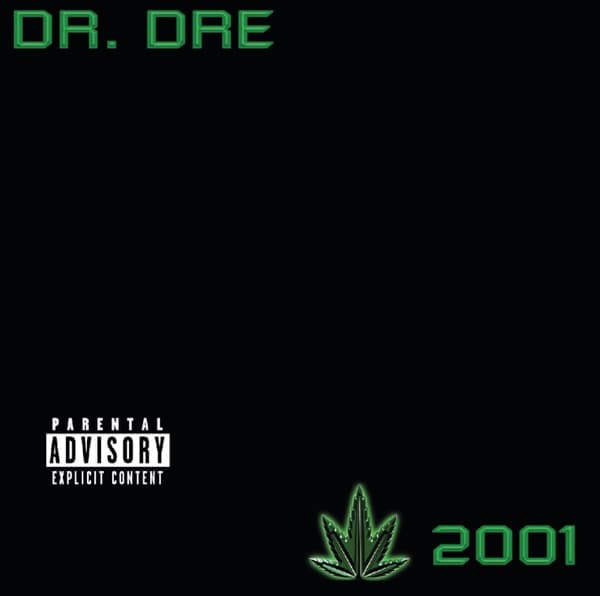
Notice how much of the cover refuses to show you anything. Nearly the entire square is black, a deep and unbroken void, and your eye is forced to travel to the edges to find any information at all. In that emptiness, the choices that remain feel deliberate and loud.
At the top left, stacked in two lines, the name Dr. Dre burns in bright green capitals. The letters glow with a slight highlight along their upper edges, as if lit from within, and their forms carry a distinctive angled cut at the ends. That lettering is Russell Square, a sans-serif with those angled terminals, drawn by John Russell and issued by VGC back in 1973. It gives the type a clipped, mechanical confidence that suits an album built on precision.
Down in the lower right corner, the same green glow spells out 2001, small and almost understated against the darkness. Between the artist name up top and the year below sits the real center of gravity: a single marijuana leaf, rendered in that identical electric green, its serrated fronds fanning upward and catching tiny points of light along the veins. It hovers just left of the year like a signature, a symbol doing the work an entire photograph might otherwise do.
The only other element is unmistakable: the bold black-and-white Parental Advisory sticker on the left side, its stacked words ADVISORY set large between the smaller PARENTAL and EXPLICIT CONTENT. On most covers that label is an afterthought pushed to a corner. Here, against so much negative space, it becomes part of the composition itself, a warning that reads as a promise.
All of this arrived on November 16, 1999, released through Aftermath Entertainment and Interscope Records. 2001 landed as a gangsta rap album, and the cover's austerity matches that identity better than any posed portrait could. There is no face, no crew, no city skyline. Just a name, a leaf, a year, and the code green pulling everything together.
The look was built by Jason Clark, who is credited across the design, the art direction, and the direction of the whole visual package. The result leans on that single accent color and lets the darkness do the rest, and the composition trusts the viewer to fill the silence.
The photography carries an oddly tangled story of its own. Donn Thompson is credited as the photographer, and the New York photographer states on his own site that he shot Dr. Dre's cover for what he calls 'The Chronic 2001' CD. The album's photography is credited to Thompson alongside Stan Musilik, with collage photography by Richard "Segal" Huredia. That trio of names points to a layered image world behind the finished sleeve, even if the front we see reduces everything to symbol and type.
There is a quiet irony in a cover so committed to photography that shows so little photographic detail on its face. The black expanse hides whatever imagery was captured and staged, leaving only the leaf and the letters to do the talking. It is a design that keeps its process in shadow, offering the audience a threshold rather than a scene.
Even the album's roster carried a phantom. Promotional posters for the record listed the rappers Sticky Fingaz and RBX, neither of whom turned up on the finished album. The names hung in the air of the marketing campaign, then quietly vanished from the tracklist, a reminder that what gets promised before release and what survives to the final version are not always the same thing.
Stand back from the cover and the logic clicks into place. The green leaf, the green Russell Square type, the black void, the stark advisory sticker: each element is chosen, none is decorative. It is a graphic-design cover masquerading as almost nothing, and that near-emptiness is exactly what makes the few surviving marks feel so charged. Your eye lands first on the glowing name, then slides to the leaf, then catches the year, and the darkness carries you between them.
That is the trick of it. A record this dense with sound wears a face this spare, letting a single luminous symbol and a handful of angled green letters stand in for everything inside. The restraint is the statement, and decades on, the black square with its bright green leaf still reads instantly, no photograph of a face required.