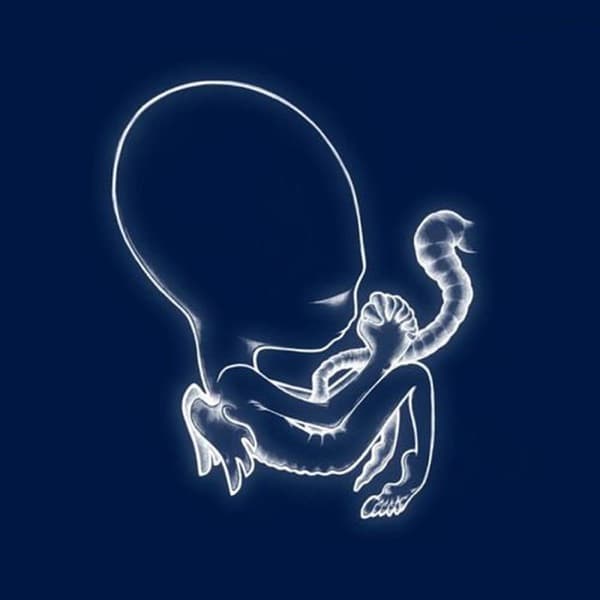

The first thing you notice is that it should not be floating like this. A human foetus curls in the center of a deep navy field, knees drawn up, oversized head bowed, the umbilical cord coiling away to the right like a question mark. And then your eye catches the wings, two ribbed, feathery shapes sprouting where shoulder blades would be, and the image tips from medical to mythological. It glows. The whole figure is rendered in luminous white outlines, as if lit from inside, suspended in darkness with nothing to anchor it.
That glow is a trick, and a good one. Icelandic artist Gotti Bernhöft drew this creature by hand with a Bic Cristal ballpoint pen, the cheapest, most ordinary writing tool imaginable. The original would have been dark ink scratched on white paper. Then the image was inverted, dark becoming light, white paper becoming that bottomless blue, so the patient crosshatching of a ballpoint turns into something that seems to radiate. Look closely at the wings and the tiny clawed feet and you can still read the nervous density of pen strokes, thousands of them, now reborn as light.
Rebirth is the whole point. Sigur Rós titled the album Ágætis byrjun, which translates as 'a good beginning,' and the band has described chasing an underwater, womb-like floating feeling in the music, a sensation they summed up as 'a foetus with wings.' The cover is that phrase made visible. A being not yet born, already given the means to fly. Themes of birth and new beginnings hang over everything here, right down to the line tucked inside the CD booklet: 'Ég gaf ykkur von sem varð að vonbrigðum... þetta er ágætis byrjun,' or 'I gave you hope that became a disappointment... this is a good beginning,' a sly nod back to the band's earlier releases Von and Von brigði.
The composition leaves the foetus almost alone. No type crowds it, no logo competes; the figure simply hovers slightly above and left of center, the large pale skull pulling your gaze first, the coiling cord and the splayed bird-feet leading it on a slow circle around the body. The negative space does the emotional work. That expanse of dark blue reads as fluid, as deep water, as the inside of something, exactly the suspended, weightless mood the music reaches for.
The album came out on 12 June 1999, released through Fat Cat and Smekkleysa, and what followed was the band's breakthrough, the record that carried this small Icelandic group to international acclaim. But the early life of the object was far humbler than the reputation it earned. For the first print run, the band assembled and glued the cases together themselves. Many of those CDs ended up unusable, ruined by glue stains, a homemade scramble entirely at odds with the serene, otherworldly image on the front.
It is a fitting contradiction. The cover looks like an artifact from some advanced imaging machine, an X-ray glimpse of a winged child, and it was made with the same blue pen kids use to doodle in school margins. Bernhöft's own work has long been tied to this drawing; today he still sells made-to-order recreations done exactly the way the first one was, A3 sheets of heavy 220 gram paper, the same blue Bic pen, the same patient hatching, each one another good beginning.
That is the quiet genius of it. A music of swells and held breath gets a sleeve that holds its breath too: a creature poised between two states, not yet arrived but already equipped to leave, glowing in the dark with the light of inverted ink.