
By the time Fiona Apple began making her second album, she had already learned that fame could turn a person into a character other people believed they understood. Tidal had made her a star while she was still a teenager, and the years that followed produced as much commentary about Apple's personality, body and public behavior as about her music.
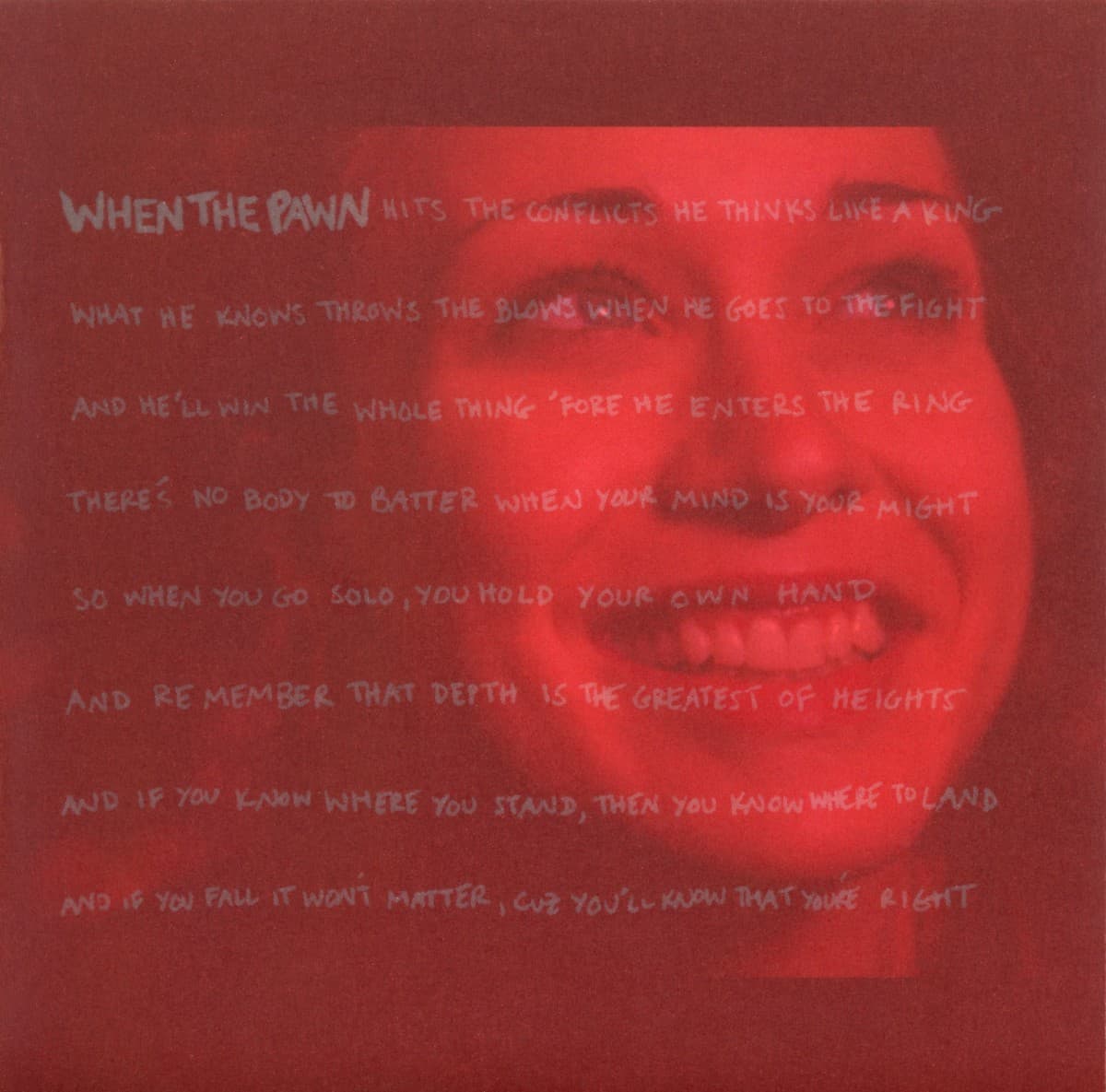
The title of When the Pawn... grew directly out of that experience. Apple wrote the 90-word poem after reading angry letters reacting to a SPIN profile. She later described being on tour, seeing the issue and becoming overwhelmed by the criticism. The poem became a way of talking herself through it: a private pep talk about holding your ground when other people have already decided who you are.
That makes the cover more than a portrait. Apple is credited with the cover-art concept and design, and the package puts her own image and her own words back under her control. Instead of giving the audience a neat slogan, she gave them a title too long to summarize comfortably. Instead of retreating from scrutiny, she placed herself on the front again.
The record's packaging therefore mirrors the album's tone. When the Pawn... is less interested in pleading to be understood than in refusing easy interpretations. Songs like 'Fast as You Can,' 'Limp' and 'Paper Bag' are full of self-interrogation, defensiveness and sudden reversals. The sleeve arrives with the same attitude: if the public wants a simple version of Fiona Apple, the album will not provide one.
The extraordinary title also became part of the cover's visual identity. In record stores, reviews and databases, it was routinely shortened to When the Pawn..., but the full poem remained the official title. That friction between the compact image of a pop star and an unwieldy block of language is central to the package. The album refuses to fit neatly even before the music begins.
Apple's design credit matters because the cover was not simply an image selected for her. It was part of the same act of authorship as the poem and the songs. The sleeve takes a period in which Apple was heavily interpreted by others and answers with something unmistakably self-authored.