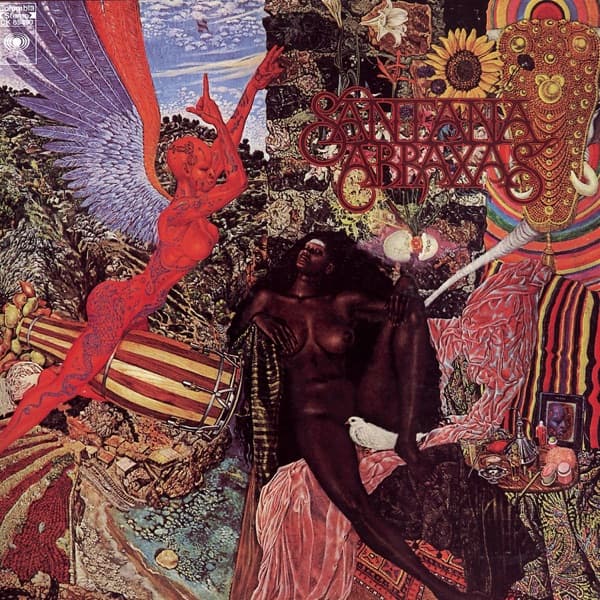
Your eye goes first to the angel: a crimson, sinewy figure with great feathered wings spread across the upper-left sky, one arm thrust heavenward, his skin crawling with intricate blue tattoos. He's perched astride a striped conga drum, finger raised toward a small Hebrew symbol floating in the clouds. This is Gabriel mid-message, and the painting is literally titled Annunciation — the moment of divine announcement, reimagined in heat and color.
Below and at the center sits a dark-skinned, naked Mary, calm and monumental, a white dove resting against her draped pink and patterned cloth. Around her the canvas erupts with fertility: a giant sunflower, lilies, an enormous golden ornamented form on the right edge, a small framed portrait tucked among objects, foliage and stone and shimmering pattern packed into every inch. The composition is dense, hallucinatory, devotional and erotic at once, with a sky of soft blue clouds opening at the top like a window in all the visual heat.
The German-French painter Mati Klarwein made this in 1961, one of the first works he completed after moving to New York City. It might have stayed a gallery curiosity if Carlos Santana hadn't reportedly come across a reproduction of it in a magazine and asked that it become the face of his band's upcoming album. The fit was uncanny — a record steeped in World rhythms and Rock fire wrapped in a painting that fused Christian iconography, African imagery, Hebrew letters and tropical abundance.
Santana released Abraxas on Columbia Records on September 23, 1970. The strange, beautiful word on the cover — woven into ornate red lettering above Mary's head, the band name curling around it like vines — comes from a line in Hermann Hesse's 1919 novel Demian, quoted on the back sleeve. There the painting itself is credited with a single name: MATI. No surname, just the signature of an artist who would go on to make images for Miles Davis, Herbie Hancock, Earth, Wind & Fire, and Gregg Allman.
Look closely and the cover rewards the search: the conga the angel rides ties the sacred scene back to the music inside, where Latin percussion drives everything. The tattoos snaking across the red figure, the egg cracked open near Mary's shoulder, the rainbow arc on the right — all of it reads as a meditation on creation and announcement, an old religious subject blown wide open into something tropical, sensual and global.
The image traveled far beyond record-store bins. Klarwein recounted seeing his painting displayed all over the world, including pinned to the wall of a shaman's mud hut in Niger and tucked inside a Rastafarian's truck in Jamaica — a piece of fine art that had become folk talisman, recognized in places that had never heard the band.
The honors followed. In 2015 the album was chosen for preservation in the Library of Congress National Recording Registry as culturally, historically or aesthetically significant, and in 2020 Rolling Stone placed it at number 334 on its 500 Greatest Albums of All Time. But the cover earns its standing on its own terms: a 1961 painting that found a second life as one of rock's most recognizable faces, where a red angel's pointing finger still pulls every eye upward.