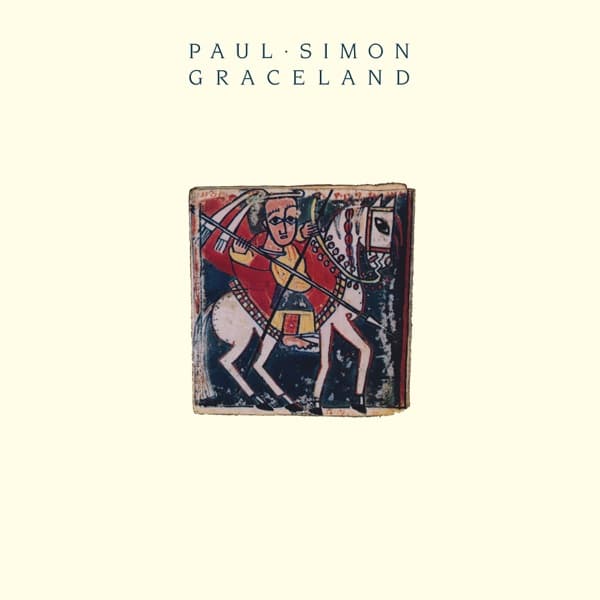
The cover of Graceland is easy to misread if you begin with the album title. There is no photograph of Paul Simon at Elvis Presley's Memphis mansion on the front sleeve. Instead, the record centers a centuries-old Ethiopian Christian image of Saint George.
The source object belongs to the Peabody Essex Museum in Salem, Massachusetts. In the museum's own account, it is a sənsul — a folding devotional book — dating to the late fifteenth or early sixteenth century, with Saint George at its center. PEM curator Karen Kramer has noted that the image later became one of the museum's most widely circulated Ethiopian images precisely because it appeared on Graceland.
For the 1986 package, Mark Sexton is credited with photographing the icon, Kim Champagne with graphic design, and Jeff Ayeroff and Jeri Heiden with art direction. Gary Heery handled back-cover photography. Those credits matter because the sleeve is not a found snapshot or a literal travel photograph; it is a modern record package built around the reproduction of a much older work of Ethiopian religious art.
That choice gives the album a visual relationship to Africa, but it should not be flattened into a simple illustration of the music Simon recorded in South Africa. Ethiopia and South Africa are different countries with distinct histories, cultures and religious traditions. The cover's Saint George image comes from Ethiopian Christian visual culture, while much of Graceland's musical story developed through Simon's collaboration with South African musicians.
The contrast is part of what makes the sleeve interesting. A white field, spare typography and a small historic image create a quiet, almost museum-catalog atmosphere around a record famous for rhythmic abundance. Rather than picture Simon, Johannesburg, Graceland mansion or the musicians themselves, the cover makes an older artwork the visual center of the album.