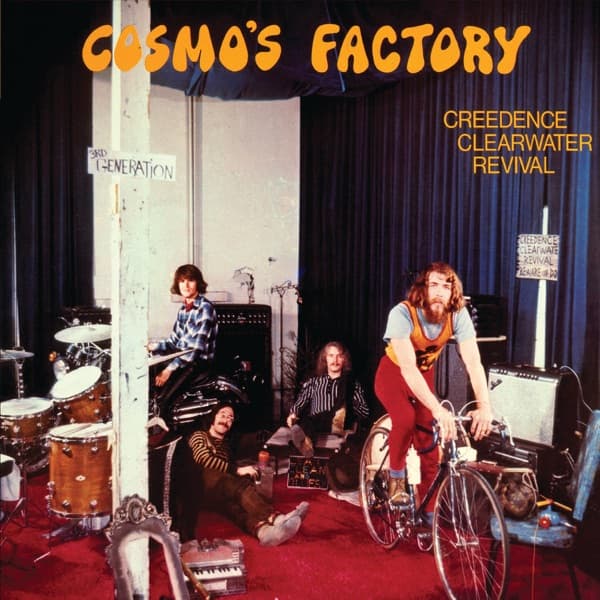
The Cosmo's Factory cover photo captures Creedence Clearwater Revival at their most deliberately uncool - four guys who looked more like lumberjacks than rock stars caught in an off-duty moment. The photograph became one of rock's most authentic band portraits, stripped of pretense and perfectly aligned with their blue-collar swamp rock aesthetic.
The image originated from a desire to thumb their nose at the establishment. Rock critic Ralph Gleason had written in the liner notes of CCR's debut album that Creedence was an excellent example of the third generation of San Francisco bands, implying they weren't as good as the Grateful Dead, Jefferson Airplane, or Quicksilver Messenger Service. The band decided to wear this criticism as a badge of honor.
The actual photo shoot was refreshingly simple and spontaneous. Bob Fogerty, brother to John and Tom Fogerty, captured the band in what appears to be a genuinely relaxed moment outside a building. There were no elaborate staging concepts or expensive production values - just four musicians being themselves in their everyday clothes and demeanor.
The most striking detail is the handwritten cardboard sign affixed to a support post that reads 3RD GENERATION. This wasn't an accident or coincidence - it was a direct, ironic reference to Gleason's backhanded compliment. The band deliberately positioned themselves with this makeshift sign as a visual middle finger to critics who viewed them as second-tier.
Behind the camera was Bob Fogerty, who had photographed previous CCR album covers and understood the band's no-nonsense aesthetic. His approach was documentary-style, capturing the group without glamour or artifice. The photograph shows John Fogerty deliberately positioned at the back, reportedly fed up with taking all the pressure on behalf of his bandmates.
The setting appears to be somewhere in the San Francisco Bay Area, consistent with CCR's working-class Northern California roots. The building's industrial backdrop reinforced their connection to honest, unpretentious American music rather than the psychedelic excess of their San Francisco contemporaries.
Upon release, the cover became emblematic of CCR's authenticity in an era of increasingly elaborate album artwork. While other bands were creating fantasy landscapes and surreal imagery, Creedence offered a snapshot that could have been taken in any American town. The image resonated with fans who saw themselves reflected in the band's ordinary appearance.
Critically, the cover was praised for its honesty, though some reviewers initially missed the subtle dig at Gleason. The 3RD GENERATION sign became more appreciated over time as fans and critics understood its context and the band's willingness to embrace their perceived outsider status in the San Francisco music scene.
Visually, the composition is deceptively simple but effective. The four band members are arranged naturally rather than formally posed, creating a sense of genuine camaraderie. The muted color palette and natural lighting give the image a timeless, documentary quality that has aged remarkably well compared to more stylized 1970 album covers.
The cover's influence can be seen in countless subsequent album covers that prioritized authenticity over glamour. Bands throughout the 1970s and beyond would adopt similar candid, unposed photography to convey their connection to working-class audiences and distance themselves from rock star pretensions.
The Cosmo's Factory cover has become iconic not despite its ordinariness, but because of it. In an industry increasingly focused on image and spectacle, CCR's decision to present themselves as regular guys was revolutionary. The cover perfectly encapsulated their music's unpretentious power.
John Fogerty later recreated the cover with his family during the 2020 pandemic, with Bob Fogerty again behind the camera. The new version, titled Fogerty's Factory, changed the sign to read 4TH GENERATION, showing how the original image's concept continued to resonate fifty years later.
Today, the original photograph stands as one of rock's most deceptively simple yet effective album covers - a perfect visual representation of a band that always chose substance over style, authenticity over artifice.