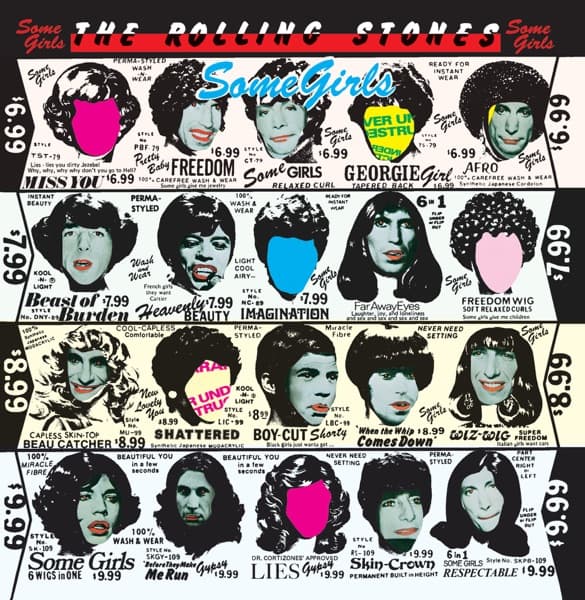


The eye lands first on the lips. Dozens of them: painted pouts glowing pink, orange and cherry-red beneath rows of towering wigs and beehives, arranged like a beauty-parlour catalogue where every model has been given the wrong head. Look longer and the joke sharpens. Peering out from under those synthetic curls are the faces of The Rolling Stones, Mick, Keith and the rest grinning, sneering and mugging in drag, slotted into hairdos advertised at prices ending in .99. This is the front of Some Girls, and it is one of the strangest bait-and-switch covers in rock.
The layout is pure retail kitsch. A red banner across the top spells THE ROLLING STONES in condensed capitals, flanked by the words 'Some Girls' repeated like a sale flyer. The title itself sits in curling blue script near the top. Down the sides run diagonal yellow price tags: $6.99, $7.99, $8.99, $9.99, each column a tier of the imaginary shop. Every portrait carries its own absurd product copy: 'PERMA-STYLED WASH & WEAR', 'AFRO 100% CAREFREE', 'NEVER NEED SETTING', 'FLIP UNDER RIGHT OR LEFT'. Style numbers, fibre claims and slogans crowd every gap.
That design was the work of Peter Corriston, with illustrations by Hubert Kretzschmar. The pair did not dream the format from scratch. They took an old advertisement from the Valmor Products Corporation, a real wig-and-beauty catalogue, and used an elaborate die-cut to punch holes where certain faces had been, so that the sleeve inside could show through the peepholes. Colours shifted from market to market, which is why the lips and background panels burn different shades on different pressings.
Kretzschmar remembered that the album carried the working title 'Lies' before it became Some Girls. A trace of that survives on the finished cover: scattered among the fake product names, the word LIES appears as its own 'style', tucked into the bottom row beside slogans like 'Skin-Crown' and 'Respectable'. The design turns song titles into merchandise, so 'Miss You', 'Beast of Burden', 'Far Away Eyes', 'Shattered', 'When the Whip Comes Down' and 'Respectable' all read as hairpieces you might order by mail.
And then there are the women. The gag was never only the band in wigs. Kretzschmar and Corriston dropped real Hollywood faces into the grid alongside them, borrowing famous likenesses without asking. That decision detonated almost immediately. Lucille Ball, Farrah Fawcett, Raquel Welch, the estate of Marilyn Monroe, and Liza Minnelli, defending the image of her mother Judy Garland, all threatened to sue over the unauthorized use of their faces.
Valmor Products Corporation was not amused either. The company whose advertisement had been lifted took its own legal action, and was awarded money for the reuse of its design. The Stones, in other words, got sued from two directions at once: by the celebrities they had inserted and by the source they had copied.
The fallout was fast and expensive. On 5 July 1978, less than a month after the album arrived on 9 June, manufacturing was halted at EMI's pressing plant once the celebrities' legal threats landed. Some Girls had been released by Rolling Stones Records; now the presses stopped.
The fix was a hasty retreat. The album was reissued with a redesigned cover that scrubbed every celebrity from the frame, replacing their portraits with flat black rectangles and garish, punk-style colour blocks. Across the empty spaces ran a cheeky apology: 'Pardon our appearance, cover under reconstruction.' You can spot the germ of it even on the fuller version, where a couple of frames sit blanked in bright pink and black with fragments of that reconstruction message showing through. The blunt magenta and yellow panels turn the beauty-catalogue joke into a confession of guilt, a sleeve caught literally covering itself up.
The visual reading only deepens the more you dwell on it. The whole thing is designed to look cheap and mass-produced, the kind of leaflet stuffed into a drugstore bag, and that flatness is the point: rock stars and screen goddesses reduced to interchangeable stock, priced, numbered, wash-and-wear. The die-cut peepholes made the sleeve half kitsch toy, half consumer satire. A version was later produced without those die-cut holes, and a still later CD reissue swapped the photographs for hand-drawn sketches of the band and celebrities.
The music behind the scandal earned the noise. Some Girls is the Stones at their most restless, folding the disco pulse of 'Miss You' into glitzy, decadent hard rock, glam and grit fighting it out track by track. The sleeve's tacky glamour and cheap thrills mirror that collision perfectly: beauty products and bad behaviour sold at the same counter.
For Corriston, the chaos launched a run. He went on to design the Stones' next three covers, Emotional Rescue, Tattoo You and Undercover, and won a Grammy for Best Album Package for Tattoo You. The wig catalogue that got yanked from the presses, sued twice over and hastily censored turned out to be the opening move of one of the great designer-band partnerships. Not bad for a sleeve where the biggest names had to be blacked out overnight.