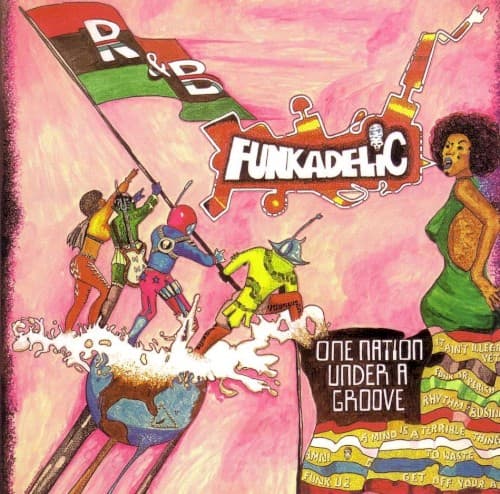


Some album covers illustrate the music. Pedro Bell's work for Funkadelic invented a universe around it. When One Nation Under a Groove arrived on September 22, 1978, the man behind the artwork didn't credit himself as a designer or illustrator in any ordinary sense — he called himself an 'electric marker heathen of speedomatic dabblings.' That single phrase tells you everything about the spirit of what you're looking at: dense, comic-saturated, gleefully unhinged, the product of a marker pen moving faster than good taste could keep up.
Bell, who also went by 'Sir Lleb,' produced the elaborate, cartoonish imagery and the liner notes for much of Funkadelic's output, and here that work crowds every available inch. His style ran on Afrofuturistic excess — figures and forms drawn in the warped, hyper-detailed register of underground comics, color piled on color, text and image fighting for the same square inch. George Clinton, who fronted the whole P-Funk collective, summed up Bell's gift with a line that doubles as the best possible description of the art: an 'urban Hieronymus Bosch' who 'inverted psychedelia through the ghetto.' Look at a Bell cover and you understand the comparison — it's psychedelia turned inside out, the cosmic swirl rerouted through the street.
What makes Bell so central to Funkadelic isn't decoration; it's authorship. He wasn't handed a concept and asked to dress it up. Through his liner notes he expanded on Clinton's ideas, fleshing out the band's mythology, essentially building the visual brand that made P-Funk a world you could enter rather than just an album you could hear. Bassist Bootsy Collins put it plainly: Bell's wild artwork was an 'essential' part of the Funkadelic experience, the thing that gave audiences a sense of the visual side of the music. The sound was free-roaming funk-rock; the covers gave that freedom a face.
The scale of his contribution lands harder when you remember how big this particular album got. One Nation Under a Groove became Funkadelic's most commercially successful release — number 1 on the Billboard Top R&B/Hip-Hop Albums chart, number 16 on the Billboard 200, certified platinum in the US. This was the record that carried Bell's electric-marker chaos into the largest audience the band ever reached. The recognition kept coming: Rolling Stone placed it at number 177 on its list of the 500 greatest albums of all time, in both the 2003 and 2012 editions.
The original US package had one more piece of generosity built in: a bonus 7-inch EP tucked alongside the main record. European buyers got a different treat — that 7-inch was swapped out for a bonus 12-inch 45 rpm mini-album. Either way, the object you brought home was more than a single LP; it was a kit, a multi-piece artifact, the physical equivalent of the overstuffed sprawl Bell drew on the sleeve.
That overstuffed quality is the whole point. A Funkadelic cover by Bell doesn't give the eye one clean place to land — it dares you to keep looking, to read the small print, to chase the gags and grotesques crawling across the frame. It mirrors the music's logic exactly: layered, restless, refusing to sit still or behave. On a band described as American funk-rock, rooted in P-Funk, the marriage of sound and image is total.
Funkadelic recorded for Warner Bros. and sold platinum, but the lasting image of the group was drawn, not photographed. Pedro Bell took an electric marker and 'speedomatic dabblings' and turned them into a brand, a mythology, a way of seeing the funk. The album went to number 1. The artwork went into the bloodstream of everything P-Funk would ever be.