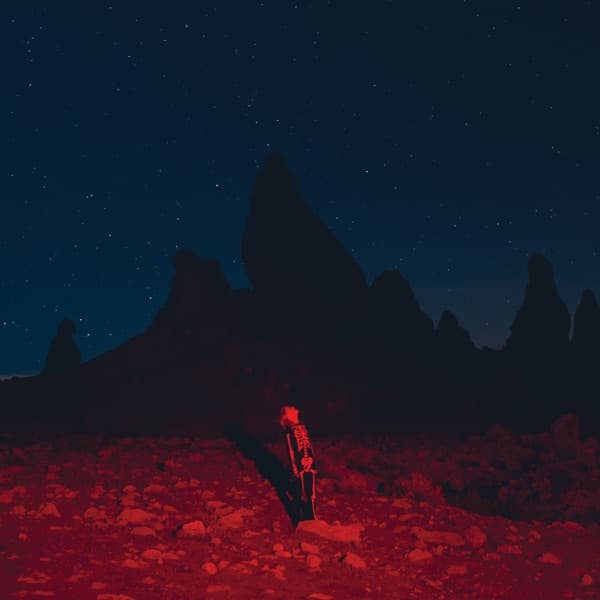

The first thing your eye finds isn't the person. It's the sky: a deep midnight blue scattered with hundreds of pinprick stars, undimmed by any city glow. Beneath it, jagged desert spires rise like black teeth against the horizon, one central peak stabbing upward toward the stars. Only when your gaze drops does the human figure appear, tiny and glowing near the bottom edge of the frame, a person in a skeleton suit lit an eerie, unnatural red, standing alone on ground that has been washed the same bloody color. She isn't looking at you. Her head is tilted back toward the sky, as if waiting for something to descend.
That something, in the concept of the image, is a spaceship. This is the cover of Punisher, the second studio album by Phoebe Bridgers, and the woman in the skeleton suit is Bridgers herself, standing alone in the desert as if waiting to be abducted by aliens. The pose is patient, almost devotional. Against the vast emptiness of the rock formations and the star field, she reads as small, exposed, and strangely at peace with whatever is coming.
The photograph is the work of Olof Grind, a queer artist based in Stockholm, Sweden, who shot the cover along with the accompanying vinyl and press images. Getting this frame meant real logistics and real darkness. Grind drove out on dirt roads into a pitch-black desert at around 3 AM, an hour that added to the adventure of the session, and set up in terrain lit by nothing but starlight.
The red is the trick, and it's worth understanding how it got there. Bridgers preferred Grind's creepiest and most surreal images, so instead of simply photographing her under the stars, he light-painted the scene. Over a single 30-second shutter, he moved a flashlight fitted with a red gel filter across the foreground while Bridgers stood completely still. That is why the ground and the figure burn with that hellish crimson while the sky above stays cool and blue: the sky is the long exposure catching starlight, and the red is Grind's hand-painted glow, brushed onto the world one sweep at a time.
Look closely at what the light actually reveals. The rocky ground is scattered with countless small stones, each catching the red beam and casting a faint shadow, giving the foreground a pebbled, almost lunar texture. The skeleton suit itself glows brightest of all, the painted white bones now flushed pink and red, so the figure looks less like a person in a costume and more like a specimen under a laboratory light. A dark shadow stretches off to her side, thrown by the moving flashlight. Everything about the lighting feels deliberate and handmade rather than natural.
The skeleton suit is not a one-off prop but Bridgers' trademark costume, and the idea for it came around the time of a second shoot in London in January. Wearing it here, dwarfed by the desert and the sky, she becomes an otherworldly figure, and the whole image tips into a post-apocalyptic feel: the last person on a scorched planet, or the first to be taken off it.
Grind didn't work alone. An assistant named Emily came along on the shoot and posed as a 'creepy naked alien' in the background. That figure doesn't appear on the front cover you see here, but she surfaces on the back cover of the vinyl, extending the abduction narrative around the physical record so the front is the waiting and the back is the arrival.
The composition makes a quiet point about where Bridgers has arrived as an artist. On her 2017 debut Stranger in the Alps, she didn't appear on the cover at all. Here she is placed small but front and center, unmistakably the subject even at that scale. She is the only warm, living thing in a cold and enormous frame, and the eye keeps returning to her precisely because she is so outnumbered by rock and star and empty air.
That tension suits the music. Bridgers rose to prominence in indie rock and makes indie folk built on acoustic guitar and electronic production, threaded through with melancholic themes. The cover translates that melancholy into a single held image: stillness, solitude, a small human looking upward and hoping to be carried away. There is no title splashed across the sky, no logo crowding the figure. The photograph is trusted to carry everything.
Punisher arrived on June 18, 2020, by way of Dead Oceans, into a year when standing alone under an empty sky felt uncomfortably literal for a lot of people. The image's mood, part longing, part dread, part cosmic surrender, landed in a moment that made its loneliness resonate beyond anything a studio could plan.
What lingers is how much feeling Grind wrung from so little: one artist, one costume, one flashlight, one gel filter, one 30-second exposure in the dark. No spaceship ever comes into frame. The red-lit skeleton just keeps looking up at the stars, forever mid-wait, and that unresolved longing is the whole story the cover tells.