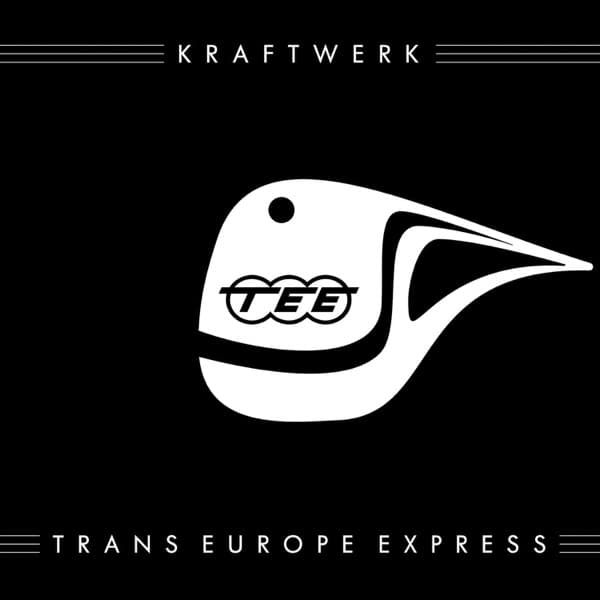
Against a field of total black, a single white shape glides: rounded at one end, tapering to a needle-sharp point at the other, like the nose of a streamlined locomotive or the head of a bird mid-flight. A small dark dot sits high near the broad end, reading instantly as an eye. A curling negative-space flourish carves through the lower body, giving the form motion even while it holds perfectly still. Dead center, framed inside the white, three interlocking circles spell out TEE in clean sans-serif, the badge of the Trans Europ Express rail network. The eye lands on that emblem first, then drifts along the elegant taper toward the point, the way a train pulls a gaze down a platform.
The typography keeps the same cool restraint. KRAFTWERK runs across the top in widely spaced capitals, flanked by sets of thin parallel rules that resemble track lines or speed marks. The full title, Trans-Europe Express, mirrors it along the bottom, letters airy and evenly kerned, the whole layout symmetrical and machined. Nothing is hand-warmed here. It is a design that wants to look manufactured, ticketed, timetabled.
That impulse runs straight through the album's making. Kraftwerk released Trans-Europe Express in March 1977 on their own Kling Klang label, and the cover was meant to push the band's image away from anything human toward the mechanical and simulated. The first plan was a monochrome picture of the group reflected in a series of mirrors, an infinity of selves. It was dropped.
In its place came portraiture built to deny portraiture. New York celebrity photographer Maurice Seymour shot the four members dressed in suits and posed to resemble showroom mannequins, faces fixed, eyes blank, men impersonating dummies impersonating men. The credits also list photography by J. Stara in Paris, whose contribution was a heavily retouched photo-montage of the group from the shoulders up, again styled as mannequins, used on the English and international version of the sleeve. Two cities, two cameras, one idea: erase the warmth, leave the surface.
The inside opened that surface back up, just slightly. Emil Schult designed a colour collage of the band seated at a small café table, assembled from a frame Seymour caught during the group's American tour. It is the closest the package comes to a human scene, four travelers paused between departures, and even there the styling keeps them poised like figures in a window display. The lettering throughout was set by Ink Studios in Düsseldorf, crisp enough to match the emblem on the front.
What makes the mannequin conceit land is how completely the record sounds like it. The genres pinned to the album range across electropop, synth-pop, experimental pop and the avant-garde, but the sensation is of a rhythm engine that never tires, a melody that glides on rails. The cover's gliding white form is the visual rhyme for that pulse: motion rendered as a smooth, repeatable shape rather than a sweating performer.
And the train kept running long after 1977. The title track became one of the most consequential pieces of music to cross the Atlantic when Afrika Bambaataa and the Soulsonic Force built their 1982 single 'Planet Rock' on its bones. A German electronic group's portrait of European railways, dressed up as dummies and reduced to a single calm emblem, became foundational to American hip-hop and electro. The cover promises something impersonal and machine-made. The legacy proves how alive that machine turned out to be.