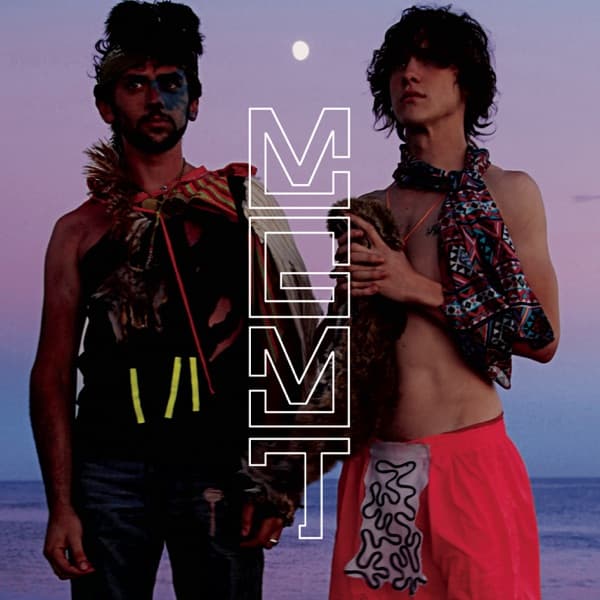
A single pale moon hangs in a bruised violet sky, and beneath it two young men stand on a darkening beach as if they have wandered out of a ritual nobody explained to them. This is the front of Oracular Spectacular, and everything about it feels caught between play and ceremony.
Look at the figure on the left first, because the eye tends to land there. He wears a black top and dark trousers, a bandana pushed back through his hair, and a slash of dark paint smeared around one eye like a bruise or a mask. A cape of feathers and striped red fabric spills off his shoulders, and slung across his chest is a strap that holds what looks like a drum or a shield of packed feathers against his hip. Two bright neon-yellow marks streak down his thigh, little lightning bolts of paint against the black. He is armored in scavenged things, none of them matching, all of them deliberate.
His partner on the right is almost his opposite. Shirtless, lean, his dark hair hanging in wet-looking waves over his face, he wears a patterned scarf knotted at his throat and hot-pink shorts printed with a squiggling white doodle near the hem. He cradles something furred and shaggy in his arms, holding it close the way you would hold an animal you were not sure of. Where the other man is fierce, he looks almost tender, almost lost.
Between them, running vertically up the center of the frame, are four hollow block letters stacked one atop the other: MGMT. The outlined, custom lettering was drawn by hand by Andrew VanWyngarden, one of the two men in the picture. Placing the logo dead center, splitting the two figures, turns the name into a kind of totem pole planted in the sand, a spine holding the whole strange tableau upright.
The men are Ben Goldwasser and VanWyngarden, the duo who are MGMT, and the primitive, tribal getups were not invented for a photo session. Sam Fleischner shot these images during the making of the music video for the band's debut single 'Time to Pretend', out near Jacob Riis Park in Brooklyn. So the costumes, the paint, the feathers and the beach were already assembled for the camera, and the cover simply borrowed a frame from that world.
That origin explains the mood. There is a loose, improvised looseness to it, the sense of two people who dressed up, drove to the shore, and were photographed before the light was gone. The sky behind them does most of the emotional work: a gradient from deep dusky blue at the horizon up through mauve and rose, the sea a flat dark band, the sand pale at their feet. Sunset light this soft flatters everything and commits to nothing, which suits an album about pretending.
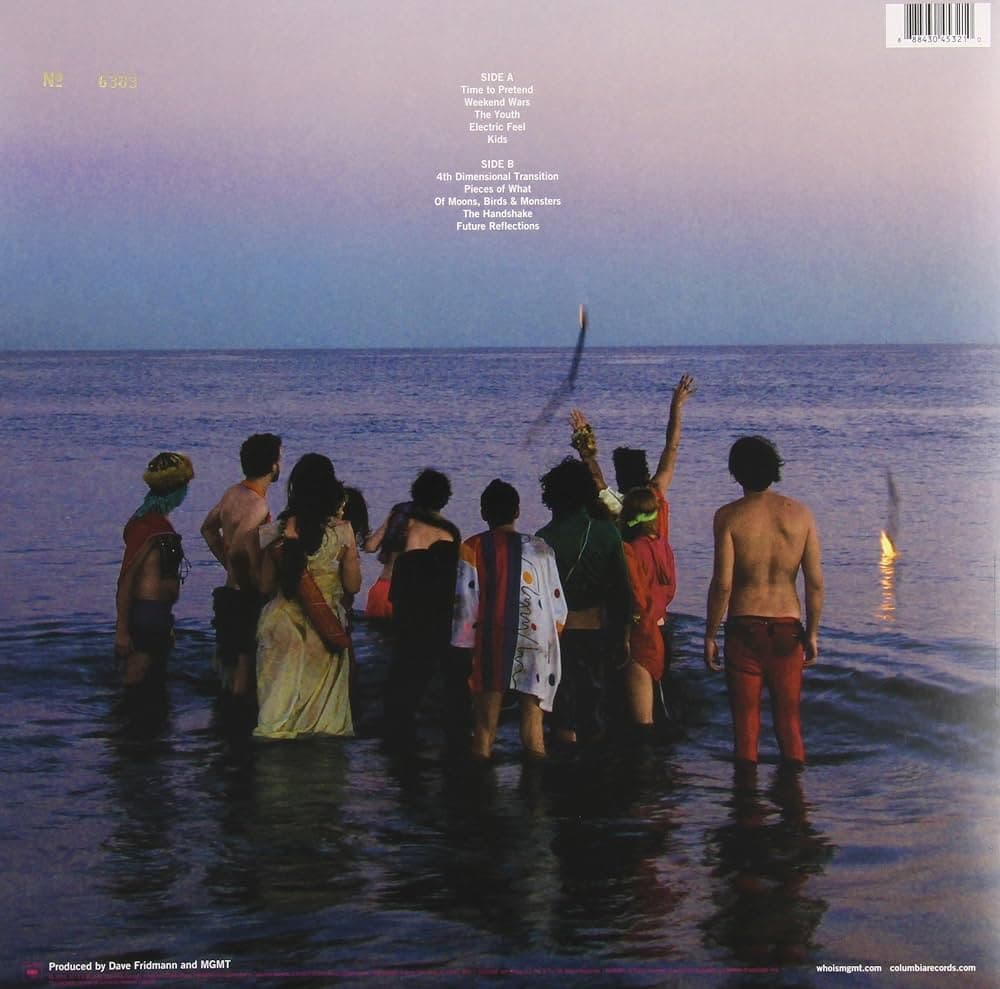
The front is only part of the story. The back cover carries the same cast into the water, where the duo stand with several others in matching primitive dress and hurl torches, fire against the dusk. The inside spread pushes the joke further, showing the pair playing with money. Costumes, flames, cash: it reads like a compressed fantasy of what fame might feel like, staged on a Brooklyn beach before any of it had actually arrived.
Because when these pictures were taken, MGMT were still a debut act. Oracular Spectacular arrived digitally on October 2, 2007, before its physical release on January 22, 2008, put out by RED Ink and pressed physically through Columbia. Art direction went to Josh Cheuse. The whole package, from the hand-drawn logo to the beachside costume drama, has the feel of a band defining its own iconography from scratch rather than inheriting one.
Critics took to it quickly, praising the production, the musical direction and the way the songs were put together. The record went on to sell more than a million copies worldwide and earned a nomination for International Album at the 2009 BRIT Awards. In 2012, Rolling Stone slotted it in at number 494 on its list of the 500 greatest albums ever made, a long-term stamp of approval on what had begun as two guys in feathers on a beach.
That is the quiet irony sitting inside the image. The lead single was called 'Time to Pretend', and here on the cover the band are literally caught in the act of pretending: dressed as something ancient and untamed, posed against a postcard sunset, holding props and animals and paint. It is dress-up elevated by conviction, two performers fully inhabiting a fiction. The pale moon, the split logo, the mismatched armor and the vulnerable bare torso all add up to a portrait of a group inventing its own myth in real time, and mostly getting away with it.
What keeps the eye moving is that unresolved tension between the two men. One is painted and plumed for battle, the other holds a small creature and looks somewhere off-frame. The stacked white letters between them refuse to let either win. You come away not with a clear message but with a feeling, half fun-house, half fever dream, which is exactly the invitation the music inside makes good on.