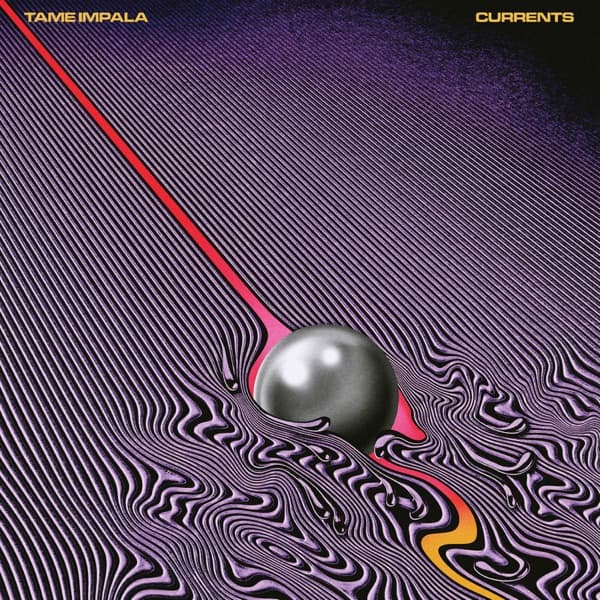


Robert Beatty created the cover art for Tame Impala's 2015 album using a combination of digital illustration and analog techniques that produced a psychedelic vortex of swirling color unlike anything in the band's previous visual identity. Beatty, a Kentucky-based artist whose work draws on the tradition of 1970s airbrush illustration and science fiction book covers, was commissioned by Kevin Parker, Tame Impala's sole studio member, to create an image that would reflect the album's exploration of personal transformation through a visual language of fluid motion and chromatic intensity.
The image depicts a spherical vortex or whirlpool of color that appears to be simultaneously spinning and collapsing inward, its bands of color spiraling toward a dark center point that reads as both a drain and a portal. The shape suggests a marble being formed, a galaxy viewed from above, or a psychedelic eye, and its organic curves contrast with the geometric precision of the spiraling lines. Beatty rendered the image using a process that involves painting and scanning, introducing the subtle irregularities of handwork into a final image that reads as digitally smooth.
The color palette moves through the full visible spectrum, from deep violet and indigo at the outer edges through blue, turquoise, and green in the middle bands to warm amber, orange, and deep red near the center. This spectral progression creates the illusion of depth, with cool colors receding and warm colors advancing, drawing the eye toward the dark central point where all colors converge and are absorbed. The transition between hues is smooth and continuous, with no hard edges between color bands, creating a fluid, molten quality that justifies the album's title.
The composition is perfectly centered, the vortex filling the square frame with a symmetry that gives it the quality of a mandala or a target. The circular form is disrupted by ribbons of color that peel away from the main spiral, creating tentacle-like extensions that reach toward the edges of the frame and suggest that the vortex is not contained but expanding, its influence extending beyond the visible boundary of the image. These extensions introduce asymmetry into the otherwise symmetrical composition, adding visual energy and the implication of motion.
The surface texture of the image hovers between the glossy smoothness of digital illustration and the organic softness of airbrushed paint. Beatty's technique produces subtle variations in color density and edge quality that prevent the image from reading as entirely computer-generated, preserving a trace of the human hand that anchors the otherworldly subject matter in physical reality. This tension between the digital and the analog mirrors the album's own production, which uses synthesizers and drum machines but processes them through analog equipment to achieve a warm, organic sound.
The typography places the Tame Impala name and album title in a font that complements the cover's psychedelic aesthetic without competing with its visual energy. The text is rendered in a tone that integrates with the surrounding colors, becoming part of the vortex rather than floating above it. This typographic integration reflects the album's own submersion of conventional song structure within waves of production and texture.
The black that appears at the center of the vortex and in the space between the spiraling color bands provides essential contrast and depth. Without these dark passages, the image would be an undifferentiated mass of bright color; the darkness gives the colors space to breathe and creates the illusion of three-dimensionality that makes the vortex appear to recede into the surface of the sleeve. The darkness also carries thematic weight, representing the unknown core of transformation around which all the album's colorful surfaces orbit.
Currents' cover revitalized the tradition of psychedelic album art for a new generation, proving that the visual language of mind-expansion and perceptual transformation could be updated without losing its power. Beatty's image has become one of the most recognizable album covers of the 2010s, its vortex reproduced on posters, clothing, and phone cases with a ubiquity that echoes the cultural penetration of the classic psychedelic covers it references. The design demonstrated that album art could still create iconic, instantly recognizable images in an era when most music was consumed as thumbnail-sized digital files.