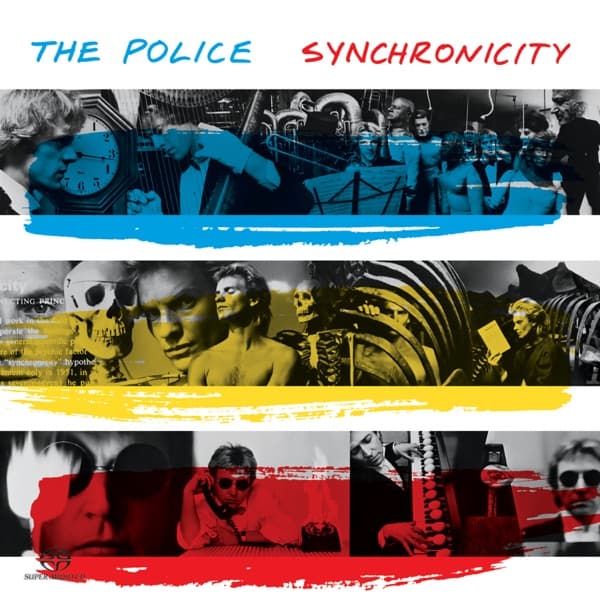
The cover of Synchronicity achieved its most striking effect purely by accident - the horizontal stripes across each band member's face weren't planned to align, but when Norman Moore laid out the three separate portraits, the lines matched up with uncanny precision. This serendipitous moment perfectly embodied the album's central concept of meaningful coincidences.
The idea emerged from the band's fascination with psychologist Carl Jung's theory of synchronicity - meaningful coincidences that seem to reveal hidden connections in the universe. Sting had been reading Jung extensively during the album's creation, and the band wanted artwork that would visualize this concept of separate elements mysteriously connecting.
Norman Moore, A&M Records' art director, commissioned renowned photographer Duane Michals to create portraits that would somehow capture synchronicity visually. Michals was famous for his sequential photography and philosophical approach to image-making, making him the perfect choice for such a conceptual challenge.
The photo shoot took place in New York, with each member of The Police photographed individually against a white background. Michals used a technique involving projected stripes and careful lighting to create the horizontal bands across their faces. The photographer treated each portrait as a separate artistic statement, not worrying about how they might work together.
Duane Michals later described the process as intuitive rather than calculated - he was more interested in creating a sense of fragmentation and multiple realities than achieving perfect alignment. The striped effect was created through a combination of projected shadows and post-production techniques, giving each portrait a sense of being sliced through different dimensions of time and space.
Norman Moore was assembling the layout when he noticed something extraordinary - despite being shot separately, the stripes across Sting's, Andy Summers', and Stewart Copeland's faces aligned almost perfectly when placed side by side. This accident became the cover's defining feature and its most powerful visual metaphor.
A&M Records initially worried the cover was too abstract and artistic for a mainstream rock album. Some executives suggested using a more conventional band photo, arguing that the striped portraits made the members difficult to recognize. However, Sting insisted the synchronicitous alignment proved the concept was meant to be.
The cover became an instant classic, praised by design critics for its sophisticated approach to visualizing abstract concepts. The artwork perfectly captured the album's themes while creating one of the most distinctive and recognizable covers of the 1980s. Many fans reported staring at the cover for hours, mesmerized by the optical effects.
The Synchronicity artwork influenced countless album covers throughout the 1980s and beyond, inspiring designers to experiment with fragmented portraits and geometric overlays. The cover demonstrated how accidents and intuition could create more powerful art than careful planning, embodying the very synchronicity it sought to represent.
Graphic design schools still study the Synchronicity cover as an example of how conceptual thinking and visual metaphor can elevate album artwork beyond mere decoration. The accidental alignment of the stripes has become one of the most famous "happy accidents" in design history.
During the album's 30th anniversary, Duane Michals revealed he still couldn't fully explain how the stripes aligned so perfectly, calling it "the kind of meaningful coincidence that Jung would have loved."