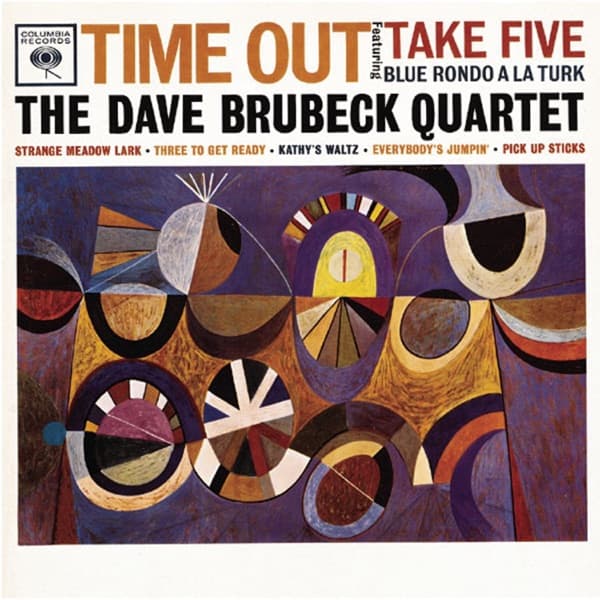

S. Neil Fujita's abstract painting for Time Out defied every convention Columbia Records had for jazz album covers. The marketing executives at the label didn't want a painting on the cover when the album debuted in 1959, preferring the usual depiction of the quartet or its leader. But Fujita's bold geometric composition would become one of the most recognizable album covers in jazz history.
The concept originated from Columbia's need to compete with the legendary cover art of Blue Note Records. After assuming artistic direction in 1954, Fujita set out to interpret and convey the same bounce, abstraction, improvisation, and freedom of the jazz artists on Columbia through abstracted pictures and images meant to communicate the avant-garde moods of the albums they adorned.
Fujita created his Time Out cover using his own colorful abstract painting, incorporating Asian-inspired colors and shapes alongside bold, stylized typography to mirror the album's rhythmic innovation. He used cut-and-paste collage elements for dynamic visual rhythm, bathing the composition in a brushy blue atmosphere that explored an implied tension between geometric order and organic chaos.
The artwork was painted using casein paints and dynamic compositions to create Fujita's signature mid-century modernist style characterized by flattened forms. His approach prioritized mood over literal representation, capturing the music's experimental spirit through visual abstraction rather than traditional band photography.
Sadamitsu Neil Fujita was born in Waimea, Hawaii, on May 16, 1921, to Japanese immigrant parents. He adopted the name Neil while attending boarding school in Honolulu. His studies at Chouinard Art Institute were interrupted by World War II and his forced relocation to internment camps, but he later served with distinction in the 442nd Infantry Regiment.
Fujita was hired by Columbia Records in 1954 after his avant-garde advertising work caught the attention of William Golden. He was the first designer to systematically commission painters, photographers, and illustrators to create cover art for Columbia's albums, revolutionizing the industry by bringing modern art sensibilities into everyday visual culture.
Columbia's marketing executives initially opposed the Time Out project, predicting commercial failure because its music was thought to be unsuitable for dancing. The abstract art cover only added to their concerns, as it contained no tried-and-true visual elements like band photos or conventional jazz imagery.
The album's experimental odd-time signatures found their perfect visual counterpart in Fujita's modernist approach. The cover helped establish the album cover as a creative art form closely tied to the music it represented, elevating album art to fine art status by merging modernist visual language with jazz's experimental spirit.
Fujita's composition features geometric shapes and blocks of mixed color that share commonalities with the work of Arshile Gorky and the Bauhaus-era style of Wassily Kandinsky. The artwork's rhythmic, color-blocked imagery visually mirrored the musical innovation within, with the asymmetrical patterns echoing the album's unconventional time signatures.
The visual design philosophy behind Time Out extended Fujita's broader mission of transforming jazz album covers from simple promotional materials into sophisticated artistic statements. His work helped establish the visual language that would define Columbia Records' jazz releases throughout the late 1950s and early 1960s.
Time Out peaked at number two on the Billboard albums chart and became the first jazz album to sell one million copies, proving that creative jazz and popular success could go together. The album's commercial triumph validated Fujita's artistic vision and Columbia's eventual embrace of his unconventional approach.
The original Time Out painting by Fujita has become highly sought after, with reproductions and homages continuing to appear in art galleries and auction houses. The cover's influence extended far beyond jazz, helping to establish the album cover as a legitimate art form in its own right.
Decades later, Fujita's Time Out cover remains a masterclass in visual-musical synergy, demonstrating how abstract art can capture the essence of experimental music without literal representation. The painting continues to be celebrated as one of the most successful marriages of modern art and popular culture.