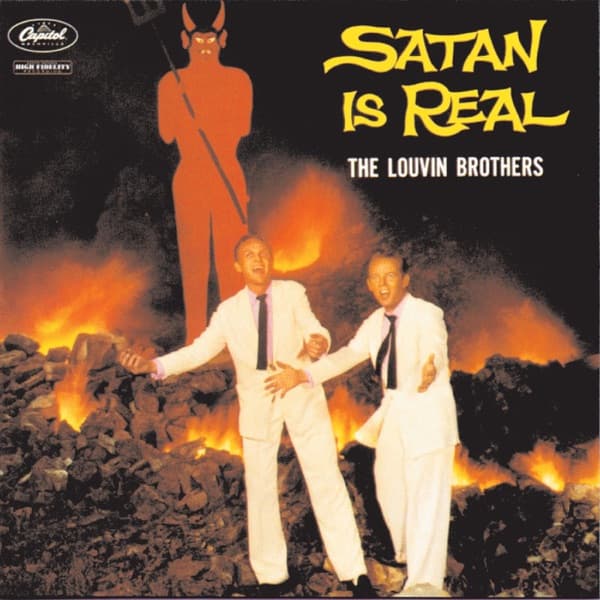
One of the most infamous album covers in music history was born from the uncompromising faith of Ira Louvin, who conceived and built every element of the hellish set for Satan Is Real. The 12-foot plywood devil, complete with horns and pitchfork, was hand-constructed by Ira himself in his vision of how he and brother Charlie Louvin had been raised to believe Satan looked.
The brothers transported their homemade Satan to a Goodlettsville, Tennessee rock quarry, where they created their own version of hell on earth. They surrounded the plywood devil with old tires soaked in kerosene and set them ablaze, creating the dramatic fire and brimstone effect. According to Charlie Louvin, they were fortunate to complete the shoot just as light rain began to sprinkle.
The photo session became dangerously realistic when kerosene-soaked rocks exploded, nearly injuring both brothers during the shoot. The liner notes on the original Capitol pressing warned that Ira and Charlie were "very nearly burned while actually directing the photography for this dramatic cover photo." William R. Eastabrook captured the memorable image of the brothers in matching white suits and black ties, arms outstretched in apparent horror before their creation.
Ira Louvin served as the album's art director, designing every aspect of the cover concept. His obsession with religious imagery was well-documented – he was reportedly known for falling into fits of faith when painting portraits of the devil. The brothers took an active role in designing their album covers throughout their career, but none would prove as enduring as this theatrical hellscape.
William R. Eastabrook worked as staff photographer for Capitol Records during this period, capturing many iconic album covers throughout the 1950s and 1960s. His photograph perfectly balanced the brothers' earnest religious conviction with the unavoidable camp appeal of their handmade Satan. The image would become one of the most recognizable album covers ever created.
When Satan Is Real was released on Capitol Records in November 1959, the cover immediately sparked conversations about its bizarre mixture of sincere spirituality and unintentional humor. Country gospel audiences of the era were accustomed to feel-good platitudes, but the Louvin Brothers delivered stark, uncompromising fire-and-brimstone Christianity that matched their dramatic cover art.
The album was recorded during marathon seven-day sessions in August 1958, when producer Ken Nelson had the brothers record enough material for two albums. While they were creating their secular Country Love Ballads, they simultaneously crafted this deeply religious work that would become their most famous release.
Visually, the cover presents a theatrical tableau that reads like a fundamentalist fever dream. The composition places the brothers in matching pristine white suits against a backdrop of blazing orange and red flames, with the crude red devil towering menacingly behind them. The stark contrast between their spotless clothing and the chaotic inferno creates an arresting visual metaphor for good versus evil.
The typography features bold, Gothic-influenced lettering that reinforces the album's ominous themes. The title "SATAN IS REAL" dominates the top of the cover in stark white letters against the dark sky, while "The Louvin Brothers" appears in smaller text. The overall design aesthetic perfectly captures the album's blend of country music sensibilities with fundamentalist religious imagery.
The cover's cultural impact has far exceeded the album's initial commercial success. It regularly appears in lists of both the best and worst album covers ever created, embodying what critic Sid Griffen called "a masterpiece of diabolical kitsch, both heartfelt and hilarious." The image has been parodied countless times, including by They Might Be Giants and Alex Hirsch of Gravity Falls fame.
Critically, the cover transcended novelty to become genuinely influential. The image captures the essential tension between sincere religious conviction and theatrical presentation that would influence generations of artists. From Johnny Cash's apocalyptic imagery to contemporary alt-country's fascination with sin and redemption, traces of this cover's impact can be found throughout American music.
Despite its initial kitsch appeal, the cover helped spark a revival of interest in the Louvin Brothers' music during the 1990s. When people discovered the album through books and websites celebrating unusual album covers, many found that the music far exceeded their expectations. The theatrical cover became a gateway to appreciating the brothers' extraordinary harmonies and songwriting.
In a final irony worthy of the album's dark themes, Ira Louvin – who created songs about drunkards' doom – died in a 1965 car crash caused by another driver's drunkenness. He had been drinking himself and faced a warrant for drunk driving, yet became the victim rather than the perpetrator. The cover he created remains his most lasting artistic legacy, a testament to the power of absolute conviction transformed into unforgettable art.