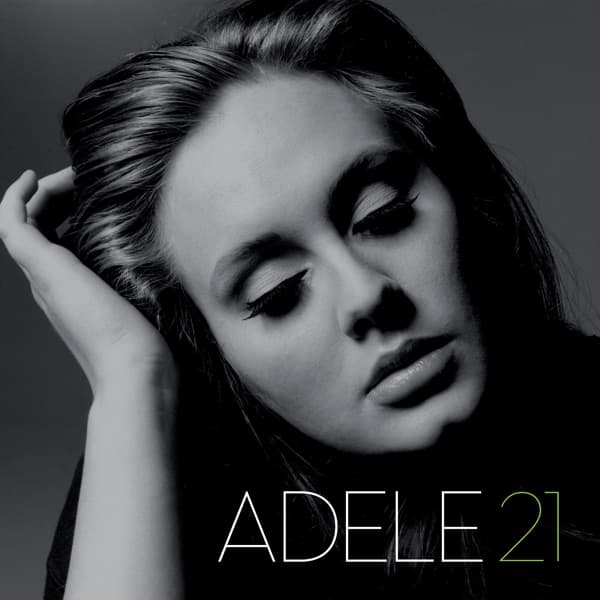
The image is a near-monochrome photograph that lets every contour do the talking. Light rakes across her forehead and the bridge of her nose, catching the strands of her swept-back hair so they shine like fine wire. The rest falls into deep shadow: the dark mass of her clothing, the smoky backdrop that shifts from charcoal at the edges to a softer pewter behind her face. Cool grays and silvery blacks hold the whole thing in a single, contained temperature, so the eye is never pulled toward a background event; there isn't one.
That tight crop is the whole drama. By pushing in so close, the picture turns ordinary features into landscape: the curve of an eyebrow, the slope of a cheekbone, the slight part of the lips. Her eyes, half closed and cast downward, refuse the usual album-cover handshake with the viewer. The effect is intimate and a little melancholy, an invitation to project whatever ache you brought with you onto the silence she's holding. The gesture reinforces it. Her hand against her own cheek, fingers disappearing into her hair, makes the pose read as self-comforting rather than presentational, as if the music inside were something she was still working through rather than displaying.
Then comes the one deliberate jolt of color. Across the lower right, her name and the number sit in clean, thin, sans-serif capitals. ADELE glows white. The 21 beside it is split: a white 2 and, unmistakably, a green 1. In a frame this gray, that single green stroke acts like a heartbeat monitor's blip, the one warm signal in a cool field. It is the kind of restraint that trusts the photograph to carry everything else, the layout stepping back so the face can hold center.
The title itself is a number, and the figure does quiet work here. Paired with that downcast, self-comforting pose, it suggests a young person taking stock, the green digit hinting at something still growing even amid the grayscale gravity of the image. The typography does the branding without shouting; a single green character is allowed to color an entire mood.
As a pop and soul portrait, the cover is a near-perfect visual promise of that blend. The soul lives in the unguarded emotion of the expression, the head-in-hand vulnerability. The pop lives in the clarity and discipline of the layout, the way the design keeps everything spare. Nothing is busy. Everything points back to the face, and the picture works because it withholds the very thing most covers offer: the gaze.