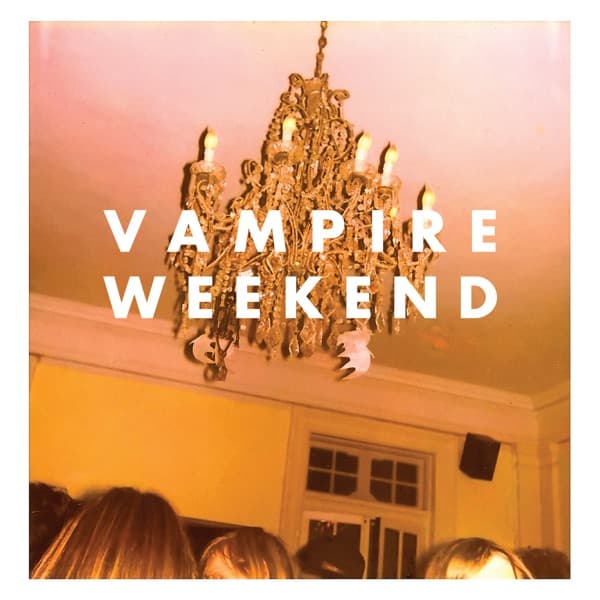

The first thing your eye catches is the light. A crystal chandelier hangs dead center, its arms loaded with candle-shaped bulbs that burn a warm amber, swimming in a wash of rose and apricot that bleeds across the ceiling like a sunset trapped indoors. The whole frame has the soft, slightly chemical glow of a Polaroid, the corners hazy, the colors not quite true. This isn't a studio shot. It's a snapshot, and that matters.
Look closer and the room reveals itself. Below the chandelier runs a band of white crown molding, then a wall of buttery yellow, a paned window with a small dark speaker mounted beside it, and along the very bottom edge, the backs of three people's heads, hair catching the light, faces turned away. You are standing at a party. Someone has lifted a camera toward the ceiling instead of the crowd, and caught the room's one piece of grandeur hanging above all the anonymous heads.
That chandelier hangs inside St. Anthony Hall, a semi-secret society at Columbia University known to those who pass through it simply as St. A's. The photograph was taken at one of Vampire Weekend's earliest shows on campus, a candid Polaroid from an actual gig rather than anything composed by a designer or styled for effect. The cover is the band's own beginning, frozen exactly as it looked.
Straddling the image in clean, wide, all-caps white letters is the name: VAMPIRE on top, WEEKEND below, the typeface plain and confident, set right across the chandelier's middle so the crystals seem to dangle through the words. There's a deliberate tension in it. Sturdy modern type laid over a flickering, faintly faded antique fixture, the new band hanging its name on an old, ornate inheritance.
That contrast is the whole record in miniature. Released on January 29, 2008, through XL Recordings, Vampire Weekend arrived blending indie pop with Afropop rhythms and threads of chamber and Western-classical music. The band had a phrase for the collision: 'Upper West Side Soweto,' citing Western classical music and Congolese soukous in the same breath. A chandelier in an Ivy League society hall is precisely the kind of preppy, privileged image that genre cocktail keeps winking at.
Using this picture was a quiet statement of where they came from. No model, no concept, no glossy art direction, just a fixture in a room where they once played. The Ivy League origins aren't hidden behind metaphor; they're literally the ceiling. It lets the cover do double duty as both a memento and a thesis, the room as both backdrop and subject.
The gamble paid off. The album debuted at number 17 on the Billboard 200 and moved more than 27,000 copies in its first week, carrying that warm amber Polaroid and its dangling crystals out of one campus hall and onto shelves far beyond it. What began as a Polaroid snapshot of a moment, the kind of photo anyone might toss aside, became the face of a debut that a lot of people remember exactly. Sometimes the most honest image is the one nobody bothered to stage.