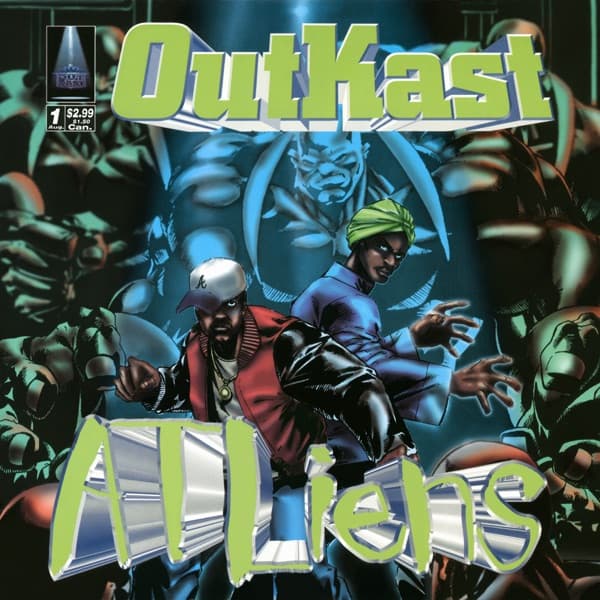


The cover of ATLiens did not come from an alien-makeup photo shoot. It came from comic books.
As OutKast finished their second album, André 3000 and Big Boi brought the title ATLiens into LaFace Records and the label's creative team began looking for a visual language big enough to match it. D.L. Warfield, LaFace's creative director, later remembered thinking that the record felt less like a conventional album than a movie. A comic-book world offered a way to make that scale visible.
The idea was collaborative. Nigel Sawyer and Vince Robinson, then working in LaFace's art department, were avid comic readers and were particularly interested in the energy of Image Comics. Sawyer later recalled that André had also been bringing Parliament records into the office, pointing toward the fantastical world-building of sleeves such as Funkentelechy Vs. the Placebo Syndrome and The Clones of Dr. Funkenstein. The goal was not to disguise OutKast as generic extraterrestrials. It was to create a larger fictional universe in which André and Big Boi could still look recognizably like themselves.
The team initially approached Spawn creator Todd McFarlane. He declined the job and the project went to illustrator Frank Gomez, who had been working in comics. Gomez drew the front cover as a dramatic superhero image: André and Big Boi stand at the center of a hostile, otherworldly scene while enormous hands and figures close in around them. André keeps the turban that had become part of his changing public image; Big Boi keeps his B-boy posture. They are heightened into comic characters without losing their Atlanta identity.
One small adjustment became one of the sleeve's most memorable local details. The first drawing did not capture Big Boi's face well enough, so Robinson sketched an Atlanta Braves cap onto him. What began as a practical fix also planted an unmistakable piece of Atlanta into the fantasy. The cover could travel into space without abandoning the city embedded in the album's title.
The front sleeve was only the entrance. The package extended the idea into a comic narrative, with Ruben 'Big Rube' Bailey credited for the storyline and Robinson credited for interior illustration and coloring. Release credits separate the roles clearly: Warfield handled art direction and the creative concept, Sawyer design, Gomez the cover illustration, and Robinson the interior illustration and coloring, with OutKast, Davett Singletary and Liwaza Green credited for creative direction.
That division of labor is part of what makes the cover interesting. ATLiens is not a photograph of two rappers pretending to be aliens. It is a deliberately constructed piece of comic-book world-building made by a label art department, illustrators and the artists themselves. The sleeve gives OutKast permission to be exaggerated, futuristic and Southern at the same time — superheroes from Atlanta rather than visitors trying to escape it.