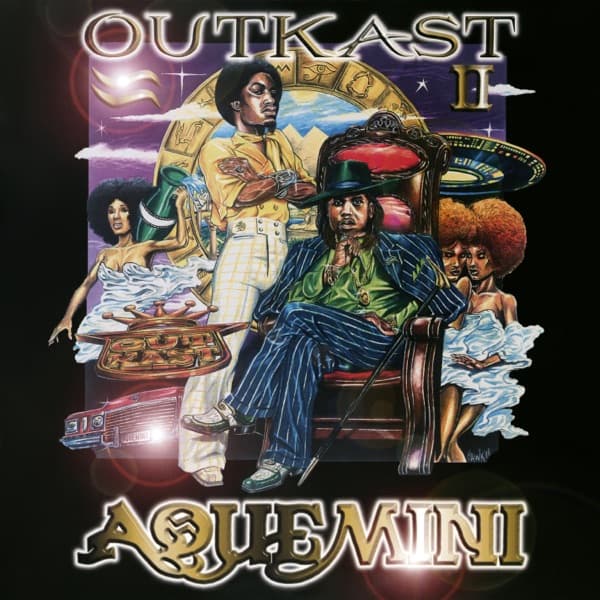


The eye lands first on the throne. A figure in a wide-brimmed black hat and a blue pinstripe suit lounges in a high-backed gold chair, one hand loose on a cane, jewelry glinting at his chest, gazing straight at you with the calm of someone who owns the room. Behind and above him stands his partner, arms crossed, mustache neat, hair pulled back, dressed in a soft yellow shirt and pale flared trousers. This is OutKast rendered not as photographs but as painted royalty, and every inch of the canvas is working overtime.
The man who painted it, Gregory Hawkins, a Columbus, Ohio native, got the job in 1998 through a phone call from Sharon Benjamin-Hodo, who told him André wanted him for the cover. André came to visit, played him the music, and asked for a 1970s vibe. So Hawkins dressed the duo in bellbottoms and what he called '70s pimp gear, leaning into the Parliament-Funkadelic feel that runs through the record (George Clinton himself appears on the album).
Look past the two figures and the background tells the rest of the story. A massive gold medallion fills the upper canvas, ringed with Egyptian pyramids and hieroglyphics. Hawkins drew it as a tribute to André's interest in Sun Ra, and as an homage to the hieroglyphic relief carvings of fellow Columbus artist Benjamin Crumpler. Just below it, a silver spaceship hovers, catching the light. Hawkins remembers André describing it as 'the descension of the mothership,' a callback to OutKast's 1996 album ATLiens and the group's Afrofuturist streak.
The composition is dense and theatrical. Women rise out of swirling white clouds on either side, one on the left and two on the right, their afros full and round, their forms half-dissolved into the mist like figures summoned rather than seated. The lower left corner holds a sliver of a red car. Across the bottom, a glowing 'OUTKAST' nameplate sits like a license plate, while the top of the frame carries 'OUTKAST II' in carved stone lettering and the title Aquemini anchors the base in ornate gold serif type with an Aquarius-style wave threading through it.
That title is the album's whole thesis in one word. Aquemini fuses the two men's zodiac signs, Aquarius for Big Boi and Gemini for André 3000, a portmanteau built around the idea that their clashing personalities are the engine of the group. The cover splits the same way: one seated, one standing, one in cool stripes, one in warm yellow, two temperaments sharing a single frame.
The whole painting came together in two or three days. Hawkins treated his first sketch as a rough draft, something he expected to refine. Then André saw it and said, 'That's it!' Hawkins colored it in and called it done, the spontaneity of the funk on the record matched by the speed of the brush.
Released on September 29, 1998, on LaFace Records (with Arista), Aquemini drew on 1970s funk, southern soul, gospel, country, and psychedelic rock, and carried the single 'Rosa Parks' to double-platinum sales, which meant Hawkins' illustration reached millions of people. Its reputation only grew: Rolling Stone ranked it number 500 in 2003, then moved it all the way up to number 49 in its 2020 list of the 500 Greatest Albums of All Time. The cover has come to be regarded as one of the great Black album covers, a two-or-three-day rush job turned into a permanent piece of the canon.