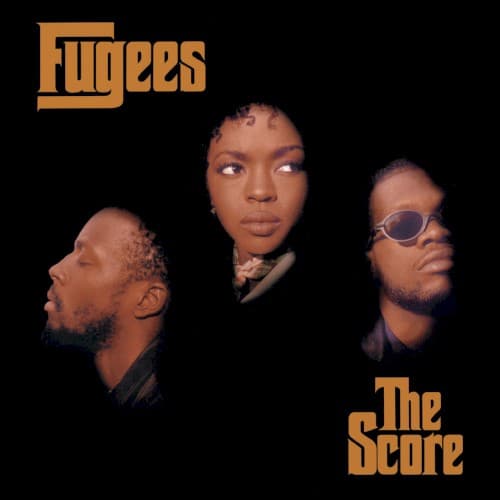
The Score is a group portrait in which nobody quite looks at anyone else.
Wyclef Jean appears at the left in profile. Lauryn Hill occupies the visual center, facing mostly forward but looking off-frame. Pras Michel sits at the right behind dark oval sunglasses, his head angled upward. All three emerge from the same deep black field, separated spatially but held together by the darkness around them.
That is the real starting point for the cover. BTC's previous version described a different object: a stark minimalist sleeve built around simple typography, a neutral background and a deliberate avoidance of elaborate photography. It then expanded that premise into claims about negative space, label anxiety, anti-glamour positioning and a broader minimalist hip-hop design movement. Those claims should not remain because the canonical front is plainly a photographic portrait and the reviewed sources do not support that invented history.
The documented creator chain is also clear. Release-level credits list Marc Baptiste for photography, BRAIN for art direction and Richard O. White for graphic design. Baptiste has separately recalled meeting Lauryn Hill while working on the Fugees' The Score cover, reinforcing his direct connection to the shoot.
The sleeve is still restrained, but for a different reason than BTC previously claimed. It strips away almost all environment so the faces become the composition. The black field does not eliminate photography; it intensifies it. The orange-gold title blocks at upper left and lower right function like graphic brackets around three disconnected expressions.
That arrangement gives the image tension. The members share one cover but seem to occupy separate psychological spaces: Wyclef turned away, Lauryn centered but looking sideways, Pras lifted behind dark glasses. It is tempting to force a symbolic story onto those sightlines, especially knowing how the group's relationships later fractured, but the evidence reviewed for this correction does not establish a creator-stated meaning. BTC should describe what is visible and documented rather than retrofit biography as intention.
The result is stronger than the fictional typography-only story. The Score's cover is memorable because it uses portraiture with unusual restraint: three stars, almost no setting, no conventional group pose and no need for visual clutter.