Before Endtroducing..... had become a landmark album, before anyone could call it a classic, DJ Shadow already knew where its cover belonged: inside a record store. Not a fashionable boutique or a carefully built set, but Records in downtown Sacramento, one of the places where the raw material of his music physically lived. Shadow had spent years searching through vinyl, and the cover would show the ritual itself.
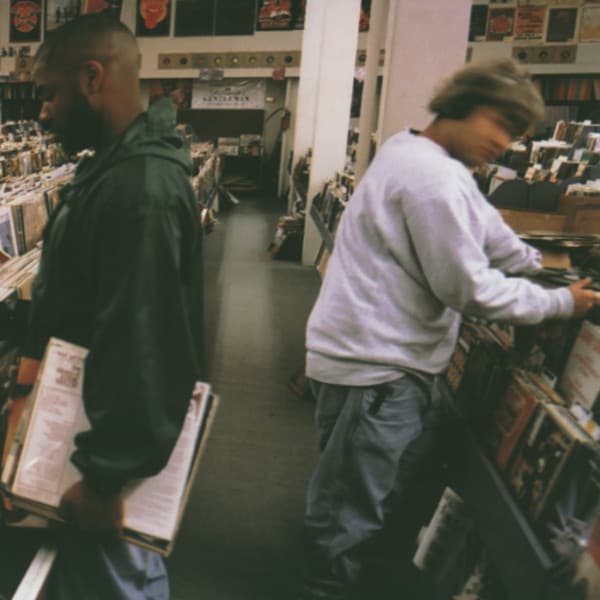
Photographer Brian "B+" Cross made the picture in May 1995. Shadow had gone into the shoot with an unusually clear idea. B+ later remembered that Josh Davis — DJ Shadow — had prepared stick-figure drawings placing everyone inside the store. The cast came from Shadow's own circle: Beni B, Chief Xcel and Lyrics Born, all part of the Northern California hip-hop world around Solesides. After hours of digging and carrying bags of records, B+ decided to shoot down the aisles and use the long perspective of the store.
Then the photograph went wrong.
B+ was working with a camera that required him to measure focus manually. Somewhere between photographer and assistant, feet became metres or metres became feet. The focal distance was set incorrectly. When the film came back, the foreground was soft and smeared rather than crisp. Lyrics Born, turning toward the camera in a white wig, seems to dissolve into motion; Chief Xcel, carrying a stack of records, holds the middle of the frame more firmly. It was the sort of mistake a commercial shoot might ordinarily discard. B+ looked at the proofs and reached the opposite conclusion: this was how the picture was supposed to look.
That accident gave Endtroducing..... a cover that behaves strangely like the music inside it. Shadow's album takes existing recordings and removes them from their original contexts, cutting, layering and recombining them until something familiar becomes difficult to place. B+'s photograph does something similar without trying. A documentary scene inside a real shop becomes dreamlike because part of it refuses to resolve. The people are recognizable but unstable; the racks of records are ordinary, yet the blur turns the aisle into something almost cinematic.
The front cover crops the wider photograph. In the fuller image, Beni B can be seen farther to the left, while Chief Xcel and Lyrics Born occupy the portion that became most familiar. None of them is DJ Shadow. That is one of the sleeve's smartest choices. The album is deeply personal, but its cover does not turn the producer into a star posing above his own work. It shows the ecosystem around him: friends, records, shelves, searching.
The location mattered just as much as the people. Records was not simply borrowed scenery. Shadow's relationship with record hunting was obsessive, and the store — including its basement — became part of the mythology surrounding his process. He would later describe extraordinary lengths taken to track down obscure records, and the 2001 documentary Scratch captured him digging through vinyl with the concentration of an archaeologist. On Endtroducing....., that behavior was already embedded in the cover before most listeners knew what the album would mean.
Ben Drury and Will Bankhead shaped the sleeve around B+'s photography. Original release credits identify both as designers, with additional package photography by Barney and Will Bankhead. The result is richer than a single iconic front image: the wider packaging turns record collecting itself into an environment. But it is B+'s accidentally misfocused photograph that carries the album's identity.
There is a final twist in the timing. The photograph was made in May 1995, well before the album's September 1996 release. It therefore does not reenact the legend of Endtroducing..... after the fact. It catches the people, place and habit before the legend existed. What looks now like an almost impossibly perfect visual metaphor was, at the time, simply Shadow's world being photographed — with one fortunate mistake in focus.