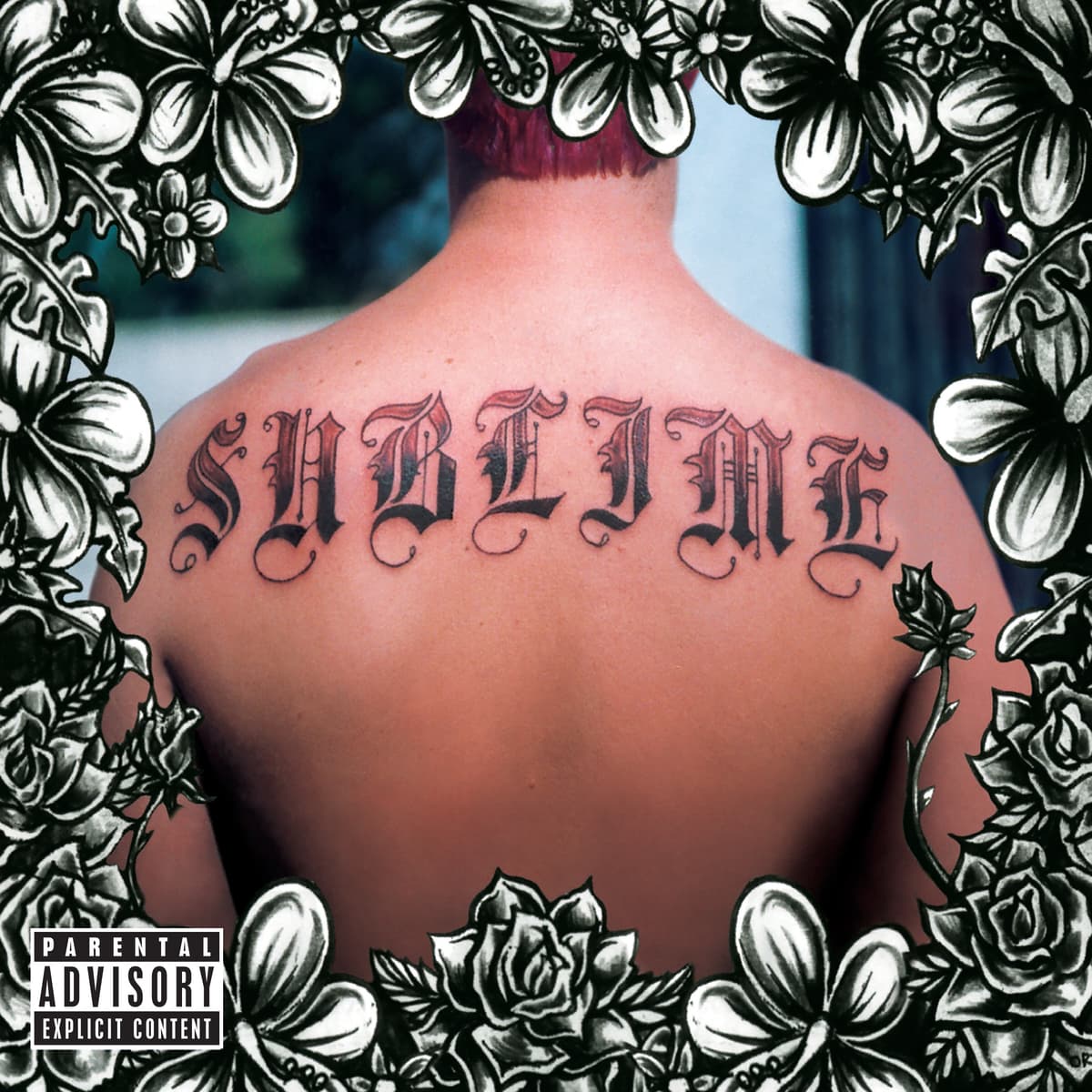

Before it was an album cover, the image on Sublime was simply proof of a tattoo between friends. Opie Ortiz had been part of the band's Long Beach orbit for years, supplying the psychedelic sun that helped define 40 Oz. to Freedom and becoming Bradley Nowell's tattoo artist along the way. When Nowell decided he wanted the band's name permanently inked on his body, he first imagined it across his stomach. Ortiz talked him out of it. A guitar would hide it, he said. The back would make it visible.
They did the tattoo in a kitchen, with Nowell lying face down while the word SUBLIME spread from shoulder to shoulder in heavy blackletter. Ortiz photographed the finished work, as tattoo artists routinely do. The rawness visible around the letters was not a graphic effect. Ortiz later explained that the red edging people sometimes assume was added in design was simply blood from a new tattoo.
At that point, nobody was making an immortal image. The band's original plan for the self-titled record was another Ortiz drawing: a disheveled clown slumped in a lounge chair amid the wreckage of his habits. Then everything changed. Bradley Nowell died on May 25, 1996, after a heroin overdose in a San Francisco hotel room. The album was still weeks away from release. Sublime had suddenly become a record by a band that no longer existed in the form that made it.
After Nowell's death, Ortiz and the team abandoned the clown as the front cover. The tattoo photograph moved to the outside, and Ortiz surrounded it with a dense black-and-white frame of flowers. The clown was pushed inside the booklet. What had been a casual record of body art became the image listeners met first when the album arrived on July 30.
That decision changed the emotional temperature of the sleeve completely. Seen without the story, the cover is almost confrontational in its simplicity: a bare back, a name, no face. Seen in the shadow of Nowell's death, the same photograph becomes a portrait through absence. The singer is there, but he is turned away. His face is withheld. What remains most visible is the name of the band he left behind, cut permanently into his skin.
Ortiz's floral border softens and complicates the photograph. The flowers are decorative, but they also give the image the feel of a frame around a relic. The black-and-white illustration presses inward toward the warm skin at the center, making Nowell's back feel less like a candid snapshot and more like an icon. The Parental Advisory label in the lower corner is almost the only element that dates it unmistakably to the CD era.
The cruel timing is part of why the image became so powerful. Sublime's biggest commercial moment arrived after its frontman was gone. The songs moved through radio, skate parks, beach towns and dorm rooms while the cover quietly introduced millions of listeners to Nowell from behind. There was no new band portrait to promote the record, no fresh photo session, no tour imagery to replace it. This one photograph had to carry the weight of the album's success and the finality of his absence at the same time.