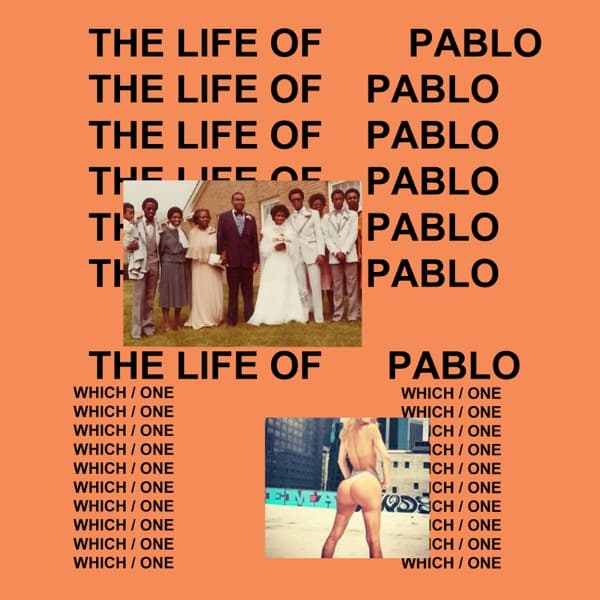




The cover of The Life of Pablo arrived at almost the last possible moment. On February 11, 2016, only hours before Kanye West premiered the album at Madison Square Garden alongside Yeezy Season 3, he posted the artwork online with a direct credit: “Cover by Peter De Potter.” The image looked less like a polished major-label sleeve than a page caught mid-layout — an orange ground, black text repeated until it collided with itself, and photographs pasted into the grid.
That was the work of Belgian artist Peter De Potter. Long before Pablo, De Potter had developed a visual language built from found imagery, typography, internet ephemera and collage. He had also spent years collaborating with Raf Simons. For Kanye, that approach became a way to make the album cover feel unstable without making it vague. The title is not discreetly typeset once. It is hammered into the surface over and over: THE LIFE OF PABLO, then WHICH / ONE, the words behaving almost like competing instructions.
The photographs deepen that tension. De Potter's studio description of the project says he and West chose to release two different covers, both using cropped images from Kanye's family photo album inside brutally overlapping grids of type. Contemporary reports focused especially on the family wedding photograph embedded in the first artwork West shared. Instead of presenting a seamless composition, the sleeve lets each element remain visibly separate: type, orange field, photograph, repetition.
The timing matters because The Life of Pablo itself resisted the idea of a final version. West had changed the album title several times before settling on The Life of Pablo, and after release he continued revising the music, altering mixes and restoring or changing parts of songs. The cover did not need to predict that behavior to fit it. It already looked editable — as if another line of text or another photograph might be added at any moment.
De Potter later pushed back on the idea that the Kanye cover was simply a commercial commission with a fixed brief. In a 2018 interview, he grouped The Life of Pablo with work that outsiders might assume required compromise, then said the opposite was true. The project sat naturally inside the visual world he had already been building. That helps explain why the cover feels so unlike conventional album packaging while still feeling recognizably his.
Its roughness was also immediately legible in 2016. Writers described the peach-orange field, repeated title and small inserted photograph almost as soon as West revealed it. The apparent simplicity became the point: the image could be recreated, parodied and remixed quickly, which made it unusually suited to the social-media environment in which the album was unfolding. Within a day, online generators were already letting people make their own Pablo-style covers.
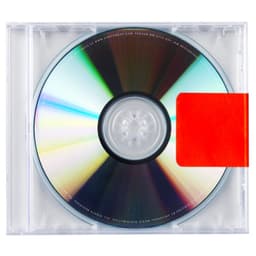
There is a useful contrast with Yeezus, the Kanye album that preceded it. Yeezus stripped physical packaging toward near-absence; Pablo filled the frame with signals and then refused to organize them politely. One cover subtracts. The other repeats. Both reject the expectation that a superstar album must arrive in a perfectly resolved visual package.
That is why The Life of Pablo remains so identifiable even though its ingredients are simple. The orange field, repeated black type and pasted photographs do not illustrate a song or depict Kanye as a heroic central figure. They make instability itself visible. The sleeve looks like something still being decided, which made it an unusually precise image for an album West would continue changing after listeners already had it.