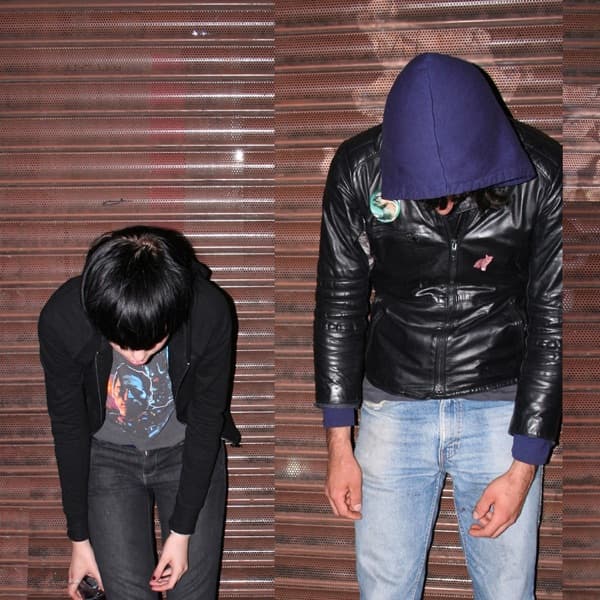
The setting does a lot of quiet work. The wall behind the pair is a corrugated metal shutter, its horizontal ribs streaked in rust and warm orange, the kind of surface pulled down over a shopfront after dark, in an alley, at the end of a night. It roots both figures in something grimy and urban and closed-for-business, a backdrop with no glamour and no depth, just texture and rust and the harsh bounce of the flash. That flash flattens everything into a cold, documentary glare, killing shadow and mood alike so the scene reads less like a portrait than like evidence.
Look closer at the left figure and the details accumulate. A black hooded zip jacket hangs open over a grey band t-shirt printed with a murky graphic; the jeans are black, the fingernails painted dark, and the hands drop toward the knees. One hand seems to clutch something small and black. The posture reads as exhaustion or collapse, a body folding in on itself.
On the right, the leather jacket is zipped tight and catches the flash in hard white highlights along every crease and seam. A round pin badge sits near the chest, a small spot of color against all that black leather, and below the jacket the jeans are pale, faded, ordinary blue. The contrast between the two, one caving inward, one squared off and blank, gives the picture its whole nervous energy.
There is no title lettering fighting for attention, no logo, no color-field, nothing to soften the scene. The photograph is left to carry everything, and its power comes from how little it explains. Where a conventional cover directs the eye toward a face and a name, this one closes every route: hair over one head, a hood over the other, a shuttered wall behind both. It is a study in refusal.
Set that beside Trevor Brown's 'Bruised Madonna' and a doubled meaning surfaces. That painting is a jarring, deliberately ugly image, turning a pop icon into a battered face and forcing you to confront it. The photograph does the opposite: instead of a violated face made unavoidable, here are two people who have made themselves unreadable, withholding every face on purpose. The band that lifted a stranger's image to represent themselves, in this frame, decline to show themselves at all.
What lingers is that tension between the two images the album is known by. One was taken from someone else and puts a damaged face in your line of sight; the other gives nothing away. Both, in their own way, are about hiding, and that is what makes the pairing hold together rather than cancel out.